What can be seen in the frame
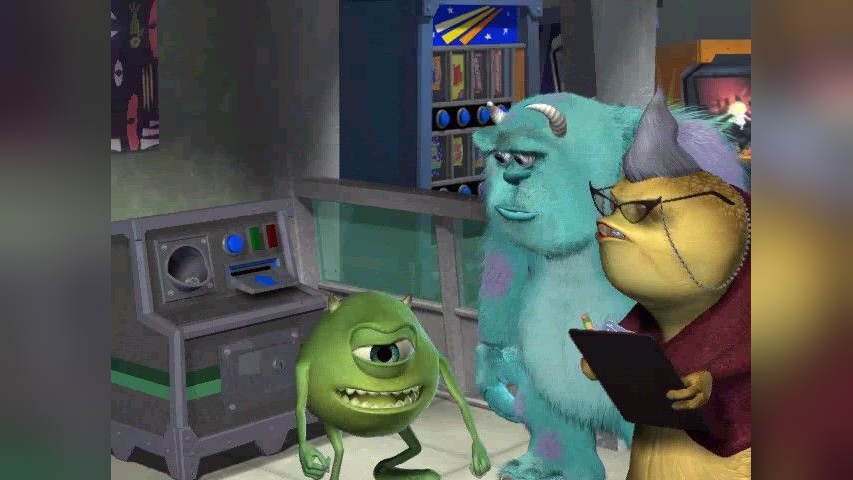
The frame shows three characters in a room with arcade machines. In the foreground on the left is Mike Wazowski: green, with one large eye, short little horns, and a wide mouth showing even teeth. He stands slightly hunched and looks almost straight at the camera, his mouth stretched in a tense grimace that resembles an awkward smile.
Behind him towers the blue Sulley with purple spots and small horns. His eyelids are half-closed, and his gaze is tired and absent. On the right stands Roz: yellow, wearing glasses on a chain and a burgundy jacket, with a dark tablet in her hands. She looks sideways with a displeased air. On the left a machine with a tray and a screen is visible, and at the top a shelf with a bright sign. There is no text in the image, so the caption creates the meaning. The frame is slightly blurred and framed by dark bars on the sides, like a freeze-frame from an old 4:3 video.
Where the frame comes from
The graphics look like a 3D intro from a computer game based on the cartoon, not like a frame from the full-length Pixar film itself. Which exact game and which exact scene cannot be reliably confirmed, so naming a specific release would be a guess.
As a template, the frame became noticeable in 2019, during the wave of reaction pictures in which characters from cartoons and films are captioned with everyday situations. The author of the first post is unknown, and the name is not needed: what matters is that the picture quickly caught on as a universal template for arguments and explanations.
How the joke works
The format is built on the gap between the speaker's confidence and the listeners' reactions. The caption usually attributes a long, self-assured explanation to Mike, while Sulley and Roz show that listening to it is pointless or unpleasant for them. Thanks to Mike's strained grin, he seems to understand that his arguments are weak but that it is too late to back down.
Each character easily takes on a role. Mike becomes the presenter who knows everything better than anyone else. Sulley embodies the weariness of those who have already heard this story. Roz with the tablet becomes the person who writes down every word in order to bring it up later against the author.
Caption examples and how they work
Four examples for different situations. They are all built the same way: the speaker promises clarity, and then explains something obvious or illogical.
“Now I'll explain why Monday is a separate day of the week. Listen carefully.” The solemn introduction does not match the mundane content, and the listeners in the frame already know the answer and are not impressed.
“Here's how the loyalty program works: first you pay, then they explain why it's beneficial.” The joke rests on the contrast between the promise of benefit and what actually happens. Roz with the tablet serves as the image of a person who writes down the terms.
“Look closely: if you keep the receipt, the refund is guaranteed. Guaranteed, do you understand?” The repetition of the word creates a pause and underlines the doubt that can be read on the characters' faces.
“I'll explain why in any group of three people there is one who has read the instructions.” The caption turns the scene into a generalization: the explainer and the listeners become roles within a group rather than characters from a cartoon.
How to use the template
The frame works well for arguments about simple things, when one person is sure and the others are not. It is better to keep the caption short: a few words before a colon or period, then a pause. It matters that the text is actually an explanation, not just a call to “look.” Without a substantive part the joke disappears, and only a set of characters remains.
Splitting the caption into roles also works well: the thesis goes above Mike, and the reaction goes above Sulley and Roz. This way the viewer immediately sees who is speaking and who is listening, and the joke reads at a glance. The more mundane the topic of the explanation, the stronger the contrast with the presenter's serious look.