What is visible in the frame
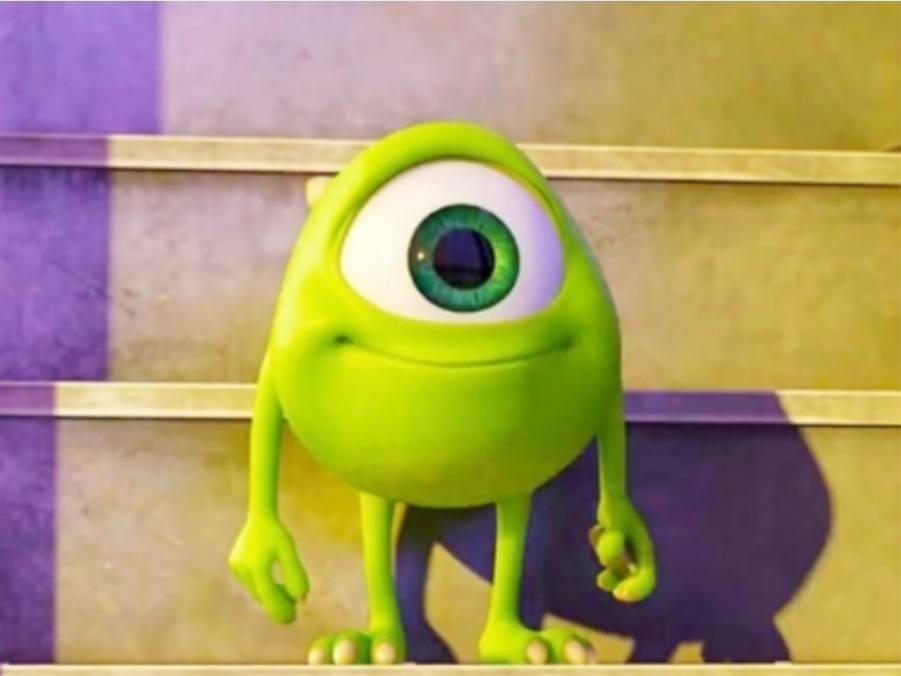
This is a computer-animated frame: a round, bright green little monster with one large eye, a turquoise iris and a calm smile. He stands on thin legs, arms hanging at his sides, and behind him are the steps of a staircase in purple and yellow tones. On the right, on the steps, lies a large dark shadow that is noticeably bigger than the hero himself — it adds the feeling that the little one is standing in front of something enormous.
This figure is smaller and softer than the adult Mike: the proportions are childlike, the head almost merges with the body, and the expression is trusting. This very combination is what makes the picture convenient for jokes about naivety.
Where the character comes from
Mike Wazowski is a hero of Pixar. He first appeared in “Monsters, Inc.” (2001) as the friend and partner of Sulley, and in the prequel “Monsters University” (2013, directed by Dan Scanlon) viewers saw him as a child and a student. Young Mike at the beginning of the film dreams of becoming a scarer, and this episode with the little hero is what people most often recall when they talk about “little Mike.”
The single eye is not seen as a flaw in the world of these films: Mike is one of many unusual creatures. His story is built on persistence: his appearance is not frightening, but his enthusiasm is boundless. Because of this, the image is easily read as “small but determined” or “small and still understanding nothing.”
Why the frame became a template
The exact date and place where this template first appeared have not been established. It is only known that the picture is taken from the cartoon, and in memes it is held up by a contrast visible in the frame itself: the trusting look of a huge eye and the shadow on the steps, which is twice the size of the character.
It works on the principle of contrast. A large eye without eyelids gives the impression that the character listens very carefully and believes every word. The smile, meanwhile, is slightly strained — one can read in it both joy and polite incomprehension. The same picture therefore suits both warm jokes and irony: it all depends on the caption.
Examples for your own caption
“I at five years old, sure that grown-ups know what they’re doing.” The contrast between childlike faith and what we understand now evokes recognition and a light sadness.
“Me when I’m told the vacation is in three months, and I’m still happy about it.” The naive joy of the little hero emphasizes how far away the date is.
“My plan for the day, before I’ve opened my work email.” The smile here works as the calm before trouble, and the shadow on the steps suggests that trouble is already close.
“First job interview, and I believe everything will go great.” Here the joke is built on the hero’s trust in the world.
How to use this template
The picture works best with first-person captions in which the hero faces something bigger than himself: huge tasks, adult problems, high expectations. If you want irony, add a detail the character clearly doesn’t notice — then his smile becomes funnier.
Don’t attribute anger or sarcasm to the picture: it isn’t about anger. Its strength lies in its softness and in the fact that the viewer knows more than the hero himself, so the most successful jokes are those where the author winks at the reader over Mike’s head.