What is in the frame
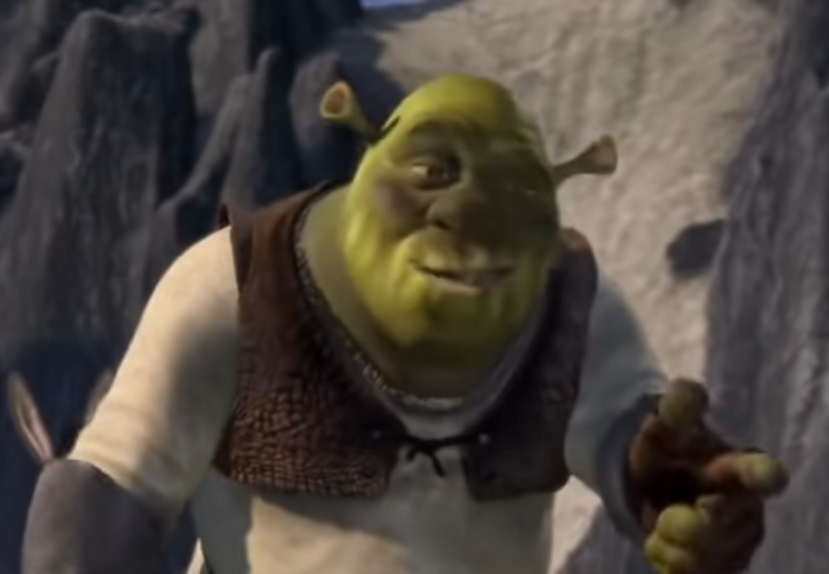
The picture shows Shrek, a green ogre with tubular ears and thick eyebrows, in a brown leather vest over a light shirt. He looks off to the side, the corners of his mouth are slightly raised, and one hand points forward with an extended finger. The background is rocky, gray-brown, with blurred cliffs.
There is no caption in the frame, so the meaning is created by the facial expression and the gesture. It is both agreement and a pause before answering: the other person seems to accept the question without yet deciding how to respond.
Where the line comes from
The frame is taken from the first “Shrek” cartoon, released in 2001. The line “Good question” attached itself to this image in the Russian-language version. The specific scene and the exact date the template appeared could not be reliably confirmed; according to reports, the meme became noticeable in spring 2019.
No author of the template is named, and there probably is none: the picture and the caption were combined by users, not by one person. So it is more honest to speak of a familiar formula rather than a documented original source.
Evasion and approval
The line sounds like a polite evasion: the question is acknowledged as legitimate, but the answer is postponed. It is a convenient way to answer awkward questions about personal life, work, or past mistakes. The viewer immediately understands that the topic is closed.
For the template it matters that the face takes up most of the frame: the sideways glance and half-smile are readable at once, even in a small preview.
Sometimes the same frame is used sincerely, when someone else's reasoning is genuinely sound. Then “good question” sounds like praise. The difference is visible only from context.
Examples of captions that work
“Why does the deadline move to Monday when it's due Friday evening? Good question.” The caption repeats the structure of the line: the question sounds reasonable, and the answer is missing. The comic effect rests on the emptiness after the word “question.”
“Do you really think this will work without tests? Good question.” The evasion replaces an honest answer, and the reader sees for themselves that there is no answer.
“How much does a renovation cost if the contractor wrote the estimate on a napkin? Good question.” The caption adds a domestic twist, and a direct answer becomes unnecessary.
“Why does everyone say the plot is clear when nobody finished reading it? Good question.” The line suits situations where the question touches several participants at once.
How to keep the joke accurate
The meme works well with captions that accept the question as reasonable and do not answer it. If the text calls for a direct answer, the template becomes too evasive and loses its meaning.
The frame carries several layers of meaning: first the line, then the picture, then the individual captions. Each layer shifts the meaning, so when choosing a text it is important to understand which one is in play: irony or praise.
The effect rests on a single movement, not on a chain of explanations: question, Shrek's half-smile and finger, “good question,” and a full stop. Any phrase after that breaks the balance, because the gesture has already served as the answer.
It only works if the question is genuine and at least somewhat awkward; then the evasion reads as a manoeuvre. If the question is silly or purely rhetorical, there is nothing to evade, and the line loses its point.
The template is also handy as a chat reaction: it is enough to send the picture without text, and everyone will understand that the other person has received a question they do not intend to answer.