A child's drawing inside a villain's project
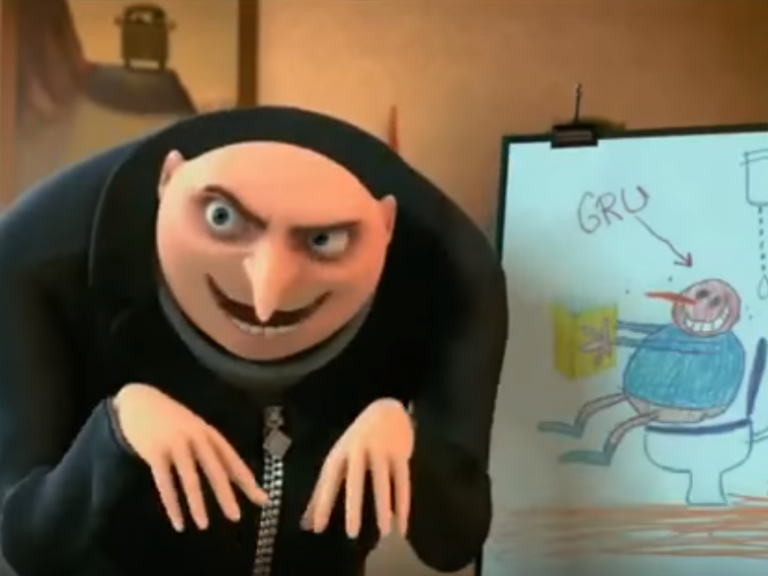
In the cartoon “Despicable Me,” released in 2010, Gru plans to steal the Moon. His grand scheme requires equipment, preparation, and money. During the presentation of his plans, the villain's seriousness collides with a drawing left by the girls: a sheet of paper shows Gru tied with an arrow to a toilet. Such an insert destroys the carefully arranged demonstration and leaves the hero vulnerable in front of his audience.
The comedy of the scene rests on a difference in authors. For Gru, the flip chart is a tool of persuasion: every sheet must confirm the thoughtfulness of the project. For the kids, the same paper serves a funny drawing. The adult keeps speaking the language of a grand operation, while the visual part already carries on its own conversation and makes him look ridiculous.
In March 2018, a four-panel remake of this presentation spread on Reddit, linked to a post by FieldMarshalSixDans in the r/deepfriedmemes community. Then the chart began to be filled with other plans. The March post became one of the early known traces of this wave; the template's exact origin is not established. The cartoon itself had already existed for several years by then.
What is visible before the punchline
Gru leans forward in a black coat and a gray striped scarf. His hands are raised under his chin, and a confident smirk remains on his face. To the right stands a flip chart: the sheet shows the word GRU, an arrow, and a drawn toilet. In the background is a warm orange wall.
This is a single frame with a filled sheet, not an empty grid of four panels. It shows the clash between a confident narrator and an unsuitable illustration, but there is no final turn of the head with bewilderment here. In the full sequence, it is the later realization that turns the presentation's mistake into a complete little story.
The plan explains its own failure
In the common template, the first panels set a goal and promise a successful course of events. The next shows an unexpected result, and the last returns attention to Gru, who notices the mismatch. The viewer manages to read the problem before the character does. The short delay between the appearance of the error and its realization replaces a full comic pause.
Plans that create the obstacle themselves work especially well. The hero tries to save time and chooses an action that makes him late; he wants to get rid of distractions and creates a new source of them. The failure then follows from the original logic rather than falling on him as a random misfortune from outside. Gru seems to be giving a convincing presentation of his own miscalculation.
The single frame also keeps part of the mechanism. It can be placed after a phrase said too confidently: the viewer sees both the winner's pose and the compromising sheet at once. But the four-panel version adds development over time: a promise, an action, a discovery, and a reaction.
Plans blocked by one step
In the fictional version, a student decides “Make the report short,” then “Add only the most important examples.” The third sheet reports: “Each example requires two more explanations.” In the last panel Gru looks over forty slides. The failure arises from the wish to be understood, so the reasonable step itself becomes a trap.
Another version begins with the plan “Don't get distracted during the game.” The hero turns off notifications, but now checks by hand every five minutes whether anyone has written. Gru's last glance is aimed at this line: the fight against distraction produced a more insistent distraction, one that does not even need a sound signal.
In a third scene, a neighbor wants to “Save space on the bookshelf” and buys an e-book. The next item on his list is buying print editions of every work he especially liked. The turn to the flip chart completes the paradox: the convenient device expanded his reading and in the end enlarged his paper library. In each story the surprise fits onto one sheet, and Gru's confident pose ties it back to the original promise.