What is in the frame
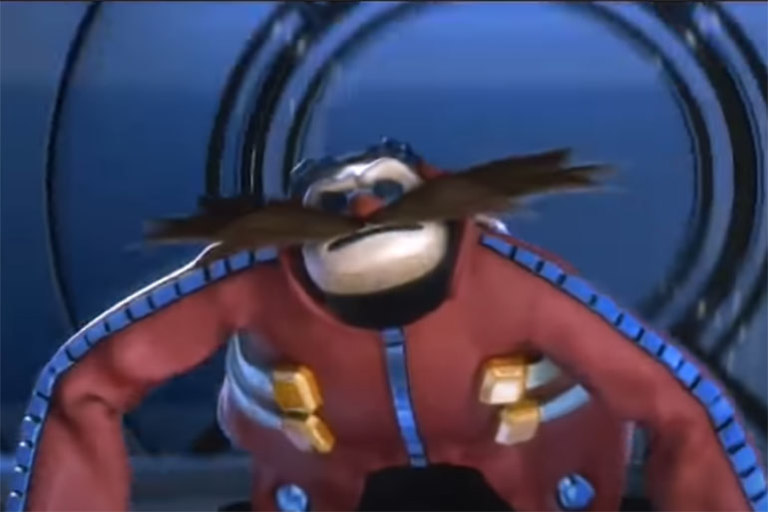
A close-up of the three-dimensional character: Dr. Eggman in a red suit with blue stripes and gold trim on the chest. His moustache covers almost all of his face, his glasses and nose barely show, and his shoulders are tilted toward the viewer. Behind him is a round blue structure of a space station.
The frame comes from a cutscene of the game Sonic Unleashed, which Sonic Team released in November 2008 for the PlayStation, Xbox 360 and Wii. At the start of the plot Eggman uses the Chaos Emeralds, and the game opens with a battle of the heroes at his station.
The amateur voice-over
The voice in the meme is not from the game but a homemade Russian dub; the words “Sanya, slyshish, prosti, ya ne khotel” (“Sanya, can you hear me, I’m sorry, I didn’t mean to”) turn the hero into a man who accidentally hurt a friend. What Eggman actually says in the game has nothing to do with the joke. Who recorded the dub and where the line came from could not be established reliably.
The earliest traces found are a clip on Coub from 22 October 2021. Its description says the sound was taken from a YouTube video with a title along the lines of “Sanya slyshish prosti menya”. The phrase probably moved to TikTok soon after, but this is a guess, not an established fact.
This happens with many amateur voice-overs: the clip lives longer than the name of its maker is known, and retellings often mix up the order of events. So this article gives only those dates that could be checked against a dated publication.
Why it is funny
Eggman is a classic cartoon villain: moustache, self-confidence, megalomania. On screen he should inspire alarm, but the amateur line makes him pitiful and mundane. The key is the Russian courtyard-style intonation: the name “Sanya” and the request for forgiveness together immediately evoke an apartment-block courtyard or a dormitory.
Beyond that, the joke runs on absurdity: an international franchise about space stations and talking hedgehogs is made to serve an ordinary quarrel between two acquaintances.
Captions
“When you borrowed a friend’s charger and showed up at his wedding with a dead phone.” Eggman apologizes for a small thing, and the caption shows how small it is.
“Me when I accidentally replied ‘haha’ to a sad message in the chat.” The frame suits awkward situations.
“Mom found where I hid the sweets.” The hero’s remorse is out of proportion to the offence, and that is what makes it funny.
“When I said ‘I’ll be right out’ and came out two hours later.” The caption turns the line into the familiar category of everyday apologies.
Notably, the meme lives mainly as sound: without the voice-over, the Eggman frame is an ordinary scene from the game. That is why it is passed around more often in videos than as a still picture, and captions are best built so that the reader hears the intonation of apology in their head.
How to use it
The template works in short videos where the picture is accompanied by a line, and in static captions about everyday wrongdoing. The smaller the offence, the better the caption: a dramatic repentance should be paired with a trifle.
The name “Sanya” can be changed to any other one — the joke doesn’t suffer. Don’t use the meme in situations where an apology is really needed: the comic effect will disappear.