Three faces in one image
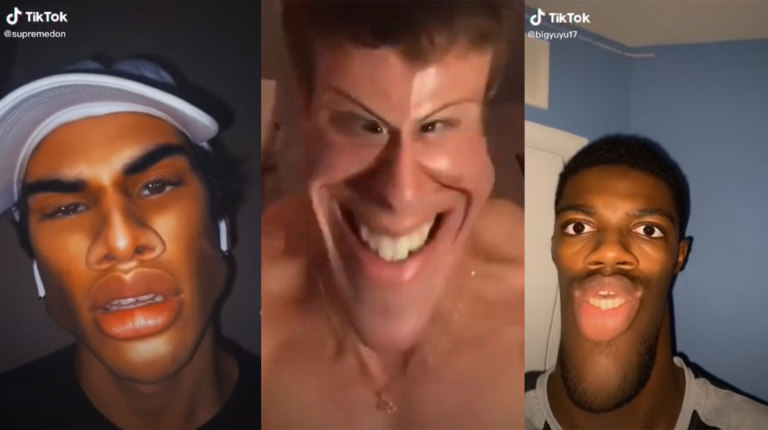
The image is a collage of three vertical frames from TikTok videos. In the left and right frames, young men have their faces badly distorted by a video effect: the chin and lower face are stretched, and the lips look unnaturally large. The left figure wears a white peaked cap and white headphones; the right one is in a dark room in front of a blue wall. In the center, a man grins with his teeth bared, his face stretched vertically and his eyes wide. The side frames show a TikTok logo and account names, but the people in the clips do not matter here: the trend depends on the effect alone.
The filter turns any face into a caricature, and that caricature is part of the joke.
Where the phrase comes from
The word dates to July 26, 1990. On The Howard Stern Show, producer Gary Dell'Abate was talking about his collection of animation film and called Quick Draw McGraw's cartoon sidekick "Baba Booey" instead of "Baba Looey". The on-air crew mocked the slip, and the phrase stuck as the producer's nickname and as a catchphrase for the show's fans, who shouted it during prank calls and in public places.
The word itself is not offensive: the original slip was just a funny mispronunciation of the name of a character.
The comeback in 2020
"Bababooey" returned as a standalone sound meme in 2020: video bloggers reportedly used it, laying the effect over unexpected words. Then TikTok videos appeared with a filter that distorts the face while a person says "baba-booey", and they quickly gathered millions of views. Sources disagree on the dates of the first clips, so it is best not to name a single launch day.
The mechanism was simple: anyone could record a clip in a few seconds, so the wave quickly became widespread, then faded just as fast, leaving behind individual jokes and the sound in the platform's library.
Most users do not know about the Howard Stern link: for them it is simply a funny voice-over.
Why it caught on
Several things worked at once. The sound is short, silly and memorable. The filter distorts the face and provides a ready-made funny visual. Finally, in the comments the word became a playful "insult" and spam: people called one another a "bababooey" for no real reason, then added the sound effect simply because it made no sense. It is an example of post-irony: the joke lies in the absurdity of repetition, not in meaning.
Caption examples and how they work
"When someone in the chat sends a seven-minute voice message" with a filtered face. The exaggerated horror on the face conveys the emotion better than words.
"My brain in class after the word 'homework'." The caption uses the stretched face as an image of a mind that has switched off.
Just the word "Bababooey" in the comments under someone else's video. The whole joke is in the impersonal repetition: the more absurd the reply, the more "correct" it is in this genre.
"Me when I hear the first few seconds of this track." The sound is used as a reaction, and the laugh comes from the match between facial expression and rhythm.
Things to keep in mind
Because of different spellings (bababoy, bababuy, Baba Booey, Bababooey), the same meme can be searched under several names. Do not use the word as a real insult aimed at an actual person: within the joke it is meant as nonsense, but in a live conversation it can sound hurtful. The TikTok clips show real people, so it is better not to caption them with other people's names or to mock a specific person's looks in earnest.