A frame with green lighting
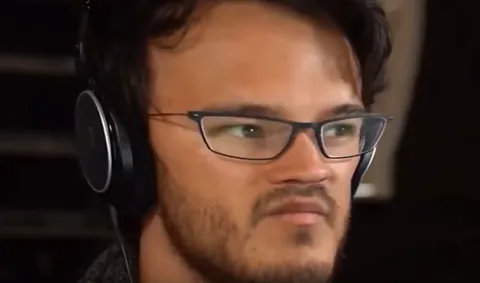
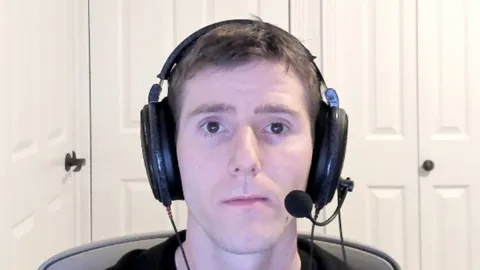
The picture shows a young man in a white sports headband with a Nike swoosh. He wears thin round glasses, and over them large black headphones with red inserts. He has a white T-shirt with black stripes on the sleeves and a collar with the Adidas trefoil. In front of him stands a microphone, behind him a chair, and in the background a sofa lit green along with a green LED strip.
The gaze is heavy and somewhat tired: eyelids lowered, head slightly tilted, lips closed. It is neither joy nor anger, but an expression that can be read in different ways: boredom, patient waiting, a silent “so what now?” It is exactly this ambiguity that makes the frame convenient for captions.
Who Buster is
Buster is the pseudonym of one of the most prominent Russian-speaking streamers. He opened a Twitch channel in 2015 and started streaming seriously in 2019, mostly around shooters like Counter-Strike and Fortnite. His audience grew in 2020. According to specialized outlets, during one stream he set a record for Russian-language Twitch with more than 750,000 concurrent viewers.
He is recognizable for his hyper-emotional style: shouting, improvisation, quick reactions to what is happening. Besides streaming he ran business ventures in esports and the gaming industry, but for the meme's topic this is secondary. It is enough to remember the main thing: his public image is loud, and against that backdrop a calm frame looks like an exception.
Why the frozen gaze is funny
The meme rests on contrast. Viewers are used to seeing the hero in a state of excitement, so a frozen expression reads as a comment on what is happening: “I saw it all, but I won't react.” In this case the caption acts as an inner voice and turns the frame into a short dialogue.
It could not be established where exactly the frame was taken or when it was first used as a template. This does not hinder the joke: it requires no knowledge of the stream's context, only a recognizable image of a person in headphones and a headband who looks tired.
Ideas for captions
Invented examples for this frame.
“When I explain for the sixth time that the ‘refresh page’ button won't hack the internet.” The face expresses patience on the verge of shutdown.
“Friend: one more match and then sleep. Time: 4:30 AM.” The combination of fatigue and honesty works here, the kind nobody admits to.
“My cat watching me assemble a wardrobe without instructions.” A variant where the tired observer is a pet rather than a person, so the joke comes out gentle.
Practical tips for use
This template works best for captions about situations where the hero has “seen it all” and no longer gets surprised: long online meetings, repeated questions, promises of “five more minutes.” A caption in the upper part of the frame reads well on the dark background; the lower part is covered by the microphone and the T-shirt.
Do not attribute to Buster real statements or actions he did not make: the picture is just a template for an expression. Captions mocking the person's appearance or health are also out of place. A good joke is built on a situation in which any viewer recognizes themselves, and on a recognizable look, not on an insult.