From short video to series
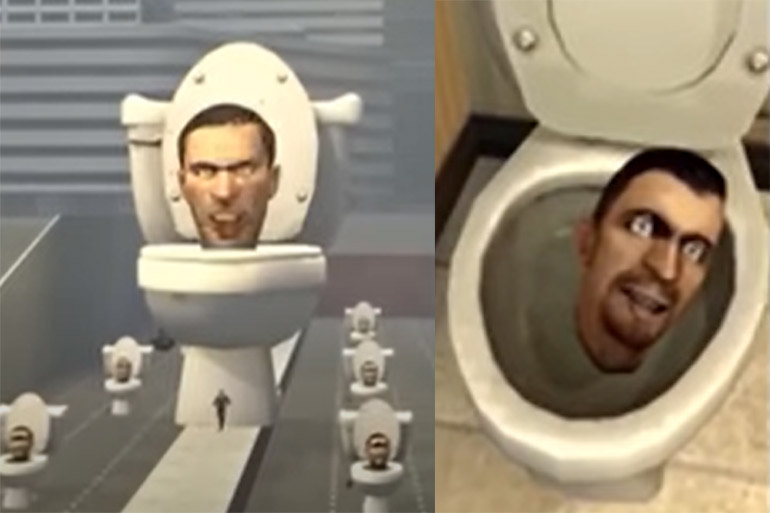
The first short episode of "Skibidi Toilet" appeared on February 7, 2023, on the channel of Georgian animator Alexey Gerasimov, who publishes work under the name DaFuq!?Boom!. In the video, a human head sticks out of a toilet and sings to an energetically edited soundtrack. It was made with 3D animation in Source Filmmaker, using familiar models from game universes. The first joke was intentionally simple and absurd: a plumbing fixture suddenly becomes a performer.
Sequels quickly changed the scale of the idea. The toilets were opposed by people with cameras for heads, then TV-headed and other characters appeared, along with allies and enemies. Short episodes began to link into a continuous story in which the repeated gag grew into a series with an escalating conflict. So "Skibidi Toilet" can mean both a specific head in a bowl and a whole universe of animated videos.
The music is also built as a remix and a loop: familiar vocal fragments are spliced into a short repeating sound. This repetition is what helped a single episode stick in memory quickly and gave users material for parodies, dances, and their own edits. Not every video of a singing head is an original part of the series: fan versions and games appeared around the idea.
Why nonsense hooks people
The first version has no long exposition: the unusual image appears at once, the sound repeats, and the event can be retold in one sentence. This principle is clear even without a shared language. The longer the series developed, the more characters and plot twists appeared in it, yet the short absurd base never went away. A meme can either recall the early episode or joke about the excessive popularity and constant expansion of this universe.
In an everyday caption, what matters is the contrast between a serious event and a disproportionately absurd reaction. For example, "I opened the fridge to remember why I came" can be presented as a sudden character popping out of the fridge door. Or compare household chaos to a battle of two factions if the scene has expressive sides. A bare "skibidi" with no clear connection is not a substitute for a joke; it works better when the reader can see a specific resemblance to the image or rhythm of the original.
Which version this is
The image in the collection shows a head sticking out of a toilet, a recognizable motif of the series but not necessarily a single frame from a specific episode. You cannot reconstruct the whole timeline of characters from one image, and there is no need to pass it off as the full story. In fan videos, the music, design, and setting often change. If it's important to explain the reference, briefly name the core idea: a singing toilet as the starting point, not the whole later world of conflict.
The series has also become a subject of parodies and cultural debates about children's internet trends. You can laugh at how hard it is to explain to an adult a set of sounds and characters that is familiar to a child, but you don't have to call the audience stupid. Different viewers react to the format differently, from interest in the editing to fatigue with the repetition. That is part of the history of its spread, not proof that the meme is aimed at only one age group.
Your own version without extra noise
For a short joke, you can use a sudden appearance, an absurd standoff, or a sound that is stuck in your head. For example: "my to-do list in the morning," with one figure peeking out of a stack of papers; "two departments fighting over the last free computer," as a mini battle of factions. Such versions borrow the structure of surprise rather than repeating a long sequence from someone else's episodes.
When explaining the origin, separate Gerasimov's original series from the amateur remixes and games that appeared later. Do not credit the author with every copy, and do not transfer unconfirmed details onto a specific picture. A meme can be silly on purpose: here the starting idea was precisely the sharp collision of a toilet, a face, and energetic sound. The story is best told just as plainly, without hiding the simplicity of the original gag behind an elaborate legend.