what's shown in the picture
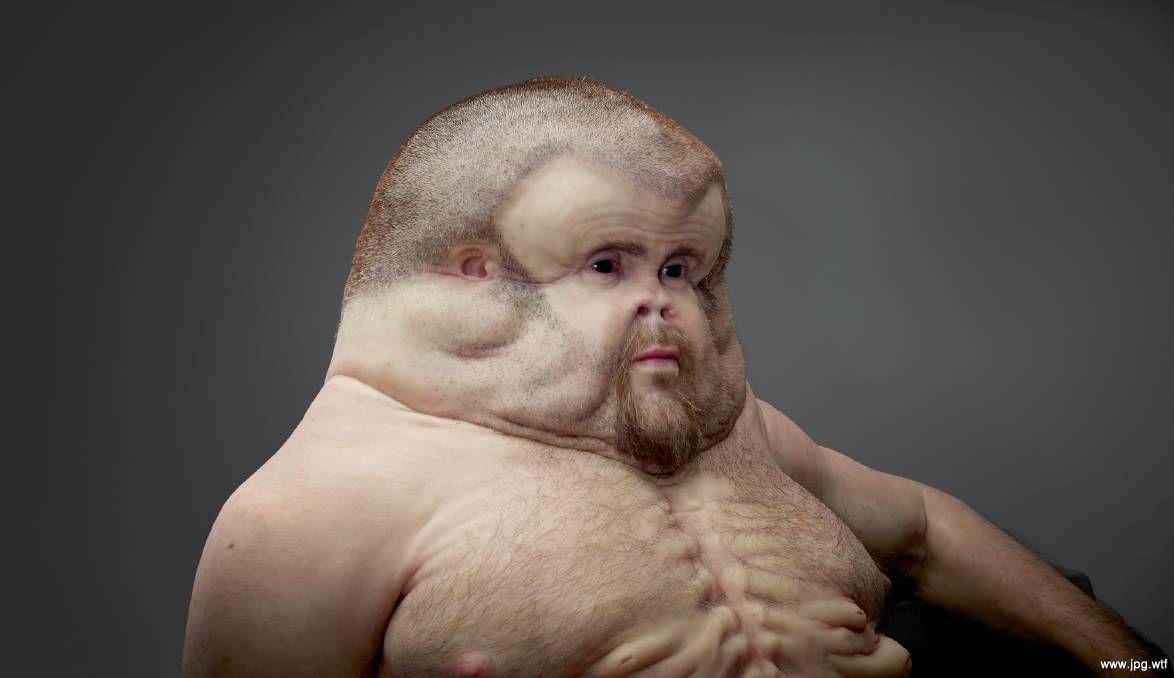
The image shows a nude figure with a disproportionately large, helmet-like head. The skull is stretched upward and backward and covered in short hair, the face looks pressed into the volume of the head, and a short beard is visible on the chin. There's almost no neck, the shoulders are massive, and the chest is wide and barrel-shaped. The background is gray and neutral, as in a studio photograph, which reinforces the sense that the viewer is looking at an exhibit.
What matters is that this isn't a photograph of a real person but a sculpture. The character was created by artist Patricia Piccinini, known for hyperrealistic sculptures of hybrid creatures. Its appearance was deliberately designed to illustrate the idea of injury protection, so it's simultaneously grotesque and technically thought through.
origin
Graham appeared as part of the Australian Towards Zero campaign, run jointly by several government agencies in the state of Victoria. The idea belongs to road safety engineer David Logan of Monash University and trauma surgeon Christian Kenfield of the Royal Melbourne Hospital. The character was conceived as a hypothetical human who had evolved to survive car crashes.
The concept is simple: cars evolved faster than people, so the human body remains vulnerable. Graham's skull became large and protective, his brain is surrounded by a large volume of fluid, he has more ligaments, no neck, and a rib cage like a barrel with pouches that work like airbags. Material about the character spread across English-language media in the summer of 2016.
how the meme is used
The meme spread when users began inserting Graham into shots from films about cars and car crashes. Photo edits show him as a passenger, driver, or pedestrian who walks away from a crash unscathed, even when the car has been turned into a pile of scrap metal. A typical caption jokes that Graham would survive any car accident.
In the Russian-speaking segment, the meme more often appears as an ironic reaction to crashes in news stories, to sarcastic comments about one's own driving, and to conversations about road safety. The joke works because the character looks alien, and the viewer channels anxiety about car crashes into play with the absurd.
why the meme works
The main reason for its popularity is the paradox: a serious life-saving project ends up looking like a horror movie character. The viewer finds it funny that a scientific idea is presented in the form of a creature that is both frightening and smile-inducing, and that contrast is what makes the meme memorable.
What's more, Graham isn't a real person, so his appearance can be played with without harming any actual individual. The meme remains a harmless game with the form and meaning of the campaign and serves as a reminder that road safety matters even when the joke is louder than the serious conversation.
place in road safety culture
The character's unusual design showed that road safety campaigns can be eye-catching and memorable. The idea that the human body is poorly suited to the speed of modern cars became understandable to a broad audience through a striking visualization, not just statistics.
At the same time, the meme doesn't replace a serious conversation about safety. It shows, rather, how an image from an advertising campaign can escape its original bounds and become part of internet folklore while still keeping its original idea of protecting life on the roads.