What is in the frame
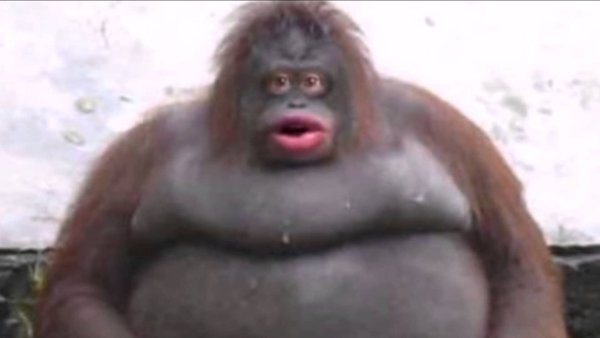
The shot is taken up close: on a light background sits an orangutan with reddish fur, its large body filling almost the entire lower part of the frame. The face is dark, the eyes are wide open, and the mouth is shaped into a small “o” with prominent pinkish lips. The expression reads as a mix of surprise and guilty bewilderment.
The photo is grainy and slightly blurred. In memes, such “low quality” only helps: the picture looks like a random frame from someone’s video.
Where the photo comes from
The photo shows an orangutan that lived in the Surabaya Zoo in Indonesia in 2009. The original photo was posted on Flickr by a user with the nickname em de a. The animal’s name is not known.
As a meme, the image appeared on January 21, 2016, on the English-language 4chan board /s4s/, where it was first captioned with the words “le monke.” Since then the name Le Monke has stuck: it is a deliberately funny spelling of the word “monkey.”
The “Uh Oh Stinky” sound
Later, the audio “Uh Oh Stinky” was added to the picture. Its basis was a joking text about a toilet mishap, posted on 4chan in the fall of 2015 and voiced by a YouTuber in March 2016. The sound gained wide popularity from the end of May 2019: it began to be used on Instagram, iFunny, and Reddit, and then on TikTok.
The Russian title “Оо стинки” repeats the English caption. It is not necessary to know the content of the spoken text: the tone in which “uh oh, it stinks” is said and the bewildered face in the picture are enough.
How the joke works
The animal’s face looks as if it has just realized what it has done and is trying to pretend that everything is fine. This mix of guilt and innocence fits everyday situations well: forgot about a meeting, said too much, broke something.
An extra comic layer comes from the delivery itself: the simple, almost childish word “stinky” paired with the serious face of an adult orangutan. The contrast is deliberately silly, so the joke works without any complicated explanation.
Where it appears
Most often the meme lives in two forms. The first is a static picture with a short caption in chats and feeds. The second is a video or an audio track in which the “Uh Oh Stinky” sound is laid over the frame, and the text on screen turns into a short skit. Both forms are built on one principle: a serious face plus childish silliness.
In practice, this means the caption can be written with the rhythm of the phrase in mind: first the situation, then an exhale with “oo” at the end. Then even without sound the viewer will hear the intended intonation and understand where the pause is.
Caption examples
All captions are made up for the article. “When I saw in the chat a message meant for a completely different person.” “Me, when Mom asked who ate the last cookie.” “Colleague: ‘Who broke the build?’ — my face.” “When it got too quiet in the elevator” — a variant for an awkward moment.
How to use it
The meme is best suited to light everyday “misdeeds.” Captions should be short, and the offense should be minor, otherwise the joke loses its harmlessness.
Do not use the picture to insult a specific person or to compare them with an animal. The orangutan here is simply a symbol of awkwardness, not a character to mock people’s appearance.