What is depicted and why it became a meme
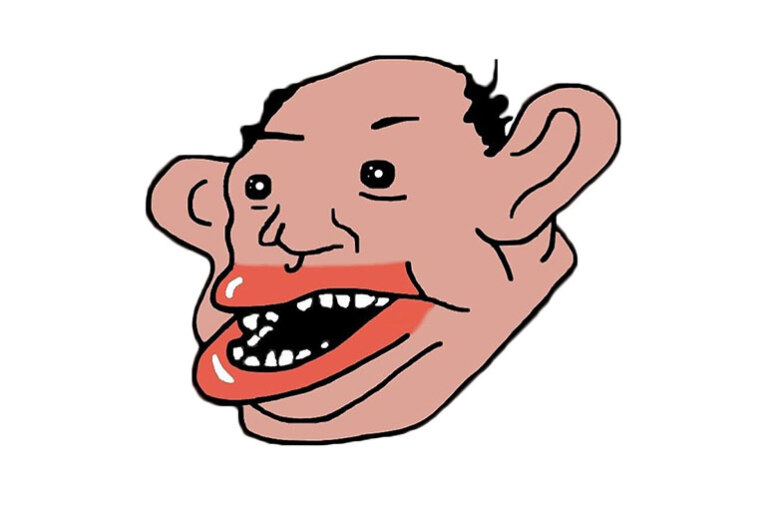
The local image is a schematically drawn face with an elongated nose and a characteristic smile. It resembles a simple internet caricature: a few lines set the expression, and a caption turns the drawing into a participant in a political argument. The picture itself does not prove that it shows a specific group of people or a real person.
The word “noviop” abbreviates the phrase “new historical community” (in Russian, “novaya istoricheskaya obshchnost”). In Soviet official rhetoric, this was how the Soviet people were described, as an emerging supranational unity. Later, the writer and publicist Dmitry Galkovsky gave the term his own sharply polemical meaning. These are different uses of one expression; merging them into a supposedly generally accepted classification is wrong.
The history of the term and the limits of fact
In the author's version, the term denoted people and elites whom Galkovsky regarded as a product of a particular Soviet identity. This is a presentation of his political concept, not a generally accepted historical or sociological conclusion. In the texts of supporters and critics alike, the word is often used as an insult, so its meaning shifts depending on the speaker and context.
The meme form helps the label live apart from the original theory: it is enough to place a drawing next to a caption for readers to recognize the contested vocabulary. However, from one picture it is impossible to establish who first attached it to the word, when this happened and which specific post launched the format. These details are not confirmed for this version.
How to read the meme
The main effect rests on caricature-like simplification: a complex history of identity is reduced to a short word and a visual mockery. For one audience it is a sign of belonging to a certain journalistic milieu; for another, a reason to ridicule the very habit of slapping on political labels. That is why the same caption can be perceived in opposite ways.
Using the word about real people transfers contested generalizations onto them and can feed hostility toward national or political groups. A responsible description separates the fact that the term and its author exist from the claims the term itself tries to impose. The picture suits an analysis of rhetoric or self-irony, but not as proof of anyone's identity.
Examples and use
In a neutral educational card, you could write: “One expression, two contexts: the Soviet formula about a shared identity and a publicist's later polemical version.” The humor here targets the confusion of terms, not the people to whom someone has assigned the label. Another example: “When a word from a history textbook got into an argument and acquired a completely different meaning.”
In a satirical format, the face can represent not a person but the habit of arguing with labels: “Out of arguments, pulled out a new definition.” A caption should come with context if the post is aimed at a wide audience. That way the reader understands that it is about the language of political polemic, not a real category of the population. Do not present a contested ideological typology as an established characteristic of people.
In editorial text, it is advisable to explain each time in what sense the word is used: as a reference to the publicist, as a historical formula or as someone else's attack. This removes the false impression that an agreed definition of the term exists. If an author wants to argue with ideas, it is better to restate them accurately and criticize the argument rather than transfer the caricature to whole communities.