What's shown
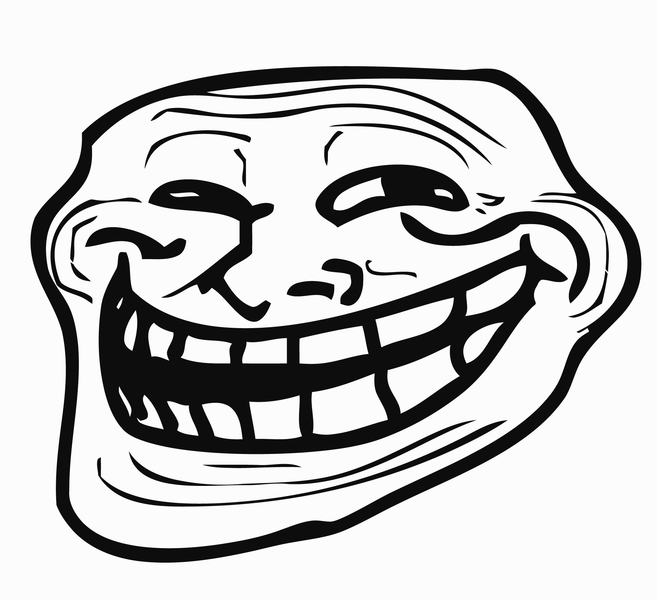
The picture is a face drawn in thin black outlines on a white background. The main features are narrow, seemingly squinted eyes, raised eyebrows, and a huge, stretched smile with an even row of teeth that takes up almost the entire lower half of the face. The expression is at once pleased and sly: it seems the owner of this face knows something the other person doesn't, and is clearly enjoying it. It's this ambiguity that makes the drawing so handy for irony.
The style resembles comic-book art: the outlines are bold, with no shading or color fills, so the image is easy to recognize even at a small size and easy to copy. That simplicity played a key role in its spread. The picture could be dropped into a comment, caption, or chat without losing its meaning, and it was recognized at a glance.
Origin
Trollface is credited to Carlos Ramirez, an 18-year-old student from Oakland, California. In September 2008 he drew the face in Microsoft Paint. It first appeared on his DeviantArt page as part of a rage comic called "Trolls." The comic itself was meant as mockery of the pointlessness of trolling: a grinning character provokes those around him, and in the end his scheme falls flat.
The rage comics genre, to which the picture belongs, was gaining popularity on forums and image boards in 2008. These were simple comics made of a few panels, where characters expressed emotions using a set of standard faces known as rage faces. Trollface quickly stood out against that backdrop because it conveyed not rage but gleeful enjoyment of provocation.
Ramirez posted the drawing on 4chan, where it began to be copied and used in discussions. In 2009 the word "trollface" appeared on Urban Dictionary, and the image then migrated to Imgur and other platforms. Unlike most internet images, the author of this meme is known by name, a rare case where the origin of the image has been reliably established.
How it's used
Trollface serves as an emotional tag: it marks a line meant as a provocation, a jab, or a deliberately awkward question. Most often the image is placed after a phrase that sounds like a challenge to the other person, for example, "are you sure the Earth is round?" The inserted face signals that the author isn't being serious and is watching for a reaction.
The paradox is that the drawing originally mocked trolls, yet trolls themselves quickly claimed it as their own symbol. So Trollface gets used both as a joke at one's own expense and as a sign of smugness. It's often compared to a child's taunt of "nyah nyah nyah" or sticking out one's tongue: a gesture that doesn't argue, it just teases.
In text exchanges the image replaces a long reply in an argument. Instead of a drawn-out argument in the thread, a face appears that says more than words. Over time Trollface became part of the language of forums, comment sections, and gaming chats, and in the Russian-speaking internet it's known as "trollface" (trollfeys).
Why the meme caught on
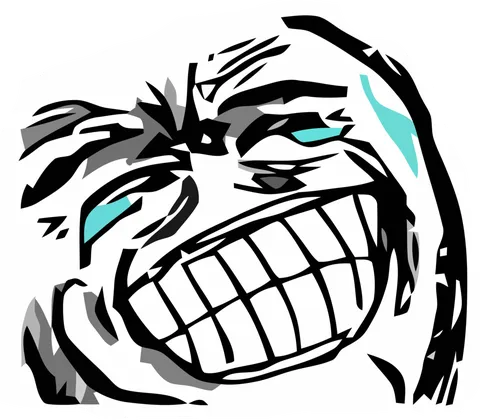
The main reason for its success is a combination of simplicity and ambiguity. The image is easy to draw, easy to recognize, and easy to modify. Hundreds of variants appeared online: realistic, colored, and even three-dimensional ones. Each version kept the main feature, the crooked grin, and carried it into a new context.
The second reason is emotional range. The same smile works as friendly teasing, as a nasty provocation, and as self-deprecation. For the internet culture of 2008-2010, when anonymous arguments in comment sections were an everyday occurrence, such a sign was in high demand: it let people express an attitude without a direct insult.
Finally, Trollface has a commercial history rare for internet symbols. According to the author, by 2015 he had earned more than $100,000 from licensing, including T-shirts sold through the Hot Topic store. The image is protected by copyright but isn't registered as a trademark. These facts show how the meme grew from an anonymous comic into a recognizable pop-culture symbol.