A face pleased with itself
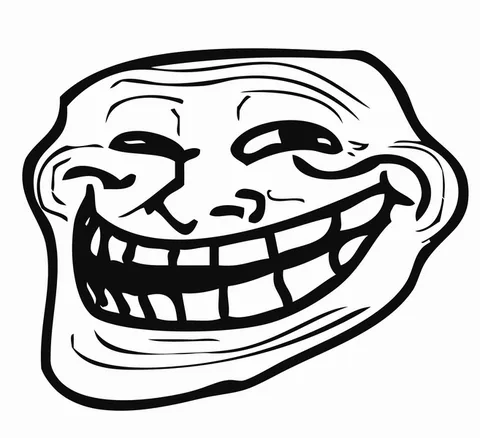
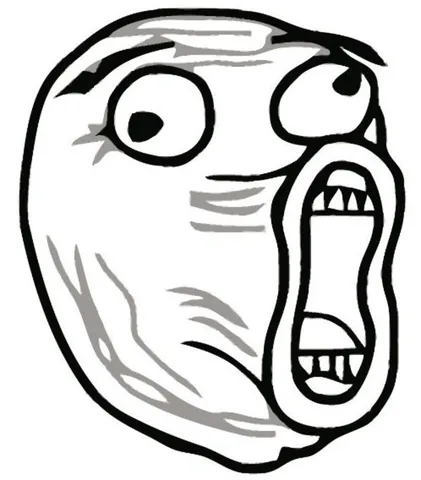
The picture shows a large face drawn with black outlines and white and gray fills. More than half of it is taken up by the smile: a broadly stretched mouth, with the teeth shown as a grid of lines. The eyes are narrowed into slits, and light-blue highlights appear on them and on the cheek, while the forehead is gathered into sharp folds. The head is tilted to one side, and a thick contour line runs along the right.
The picture looks like a vector trace, and light-blue highlights are not typical of classic rage faces. For that reason it is better to describe the template as a stylized version of a face in the spirit of rage comics rather than an exact copy of the original.
Rage comics and their faces
Rage comics, short stories assembled from a set of standard faces, emerged on the 4chan imageboard in 2008. Each face signifies an emotion: rage, surprise, satisfaction, trickery. The famous Trollface, drawn in 2008, belongs to the same family.
Big Grin grew out of the same environment. Who drew this face and when it first appeared has not been reliably established: accounts differ, and naming a date of first publication would be inaccurate. Such uncertainty is typical of rage-comic faces, which were altered and redrawn hundreds of times.
Never ever
The second name, Never Ever, is associated with a variant of the face used as a taunt. According to one version, it took shape on gaming forums, where it was posted in response to expectations of something that “will never happen.” There are few confirmed details, so the exact origin remains disputed.
The meaning does not change: the face says “I know something you don't” or “I'm pleased with how I got you.” It is a sly smile, not a mean one.
Captions for a self-satisfied face
Below are four invented captions. The face works when a small victory is described in detail and offends no one.
“Moved the deadline to Monday, and nobody noticed.” The face shows pleasure at a small piece of cunning, and the hero looks clever but not malicious.
“Took the last pastry for myself while everyone was discussing diets.” The scale of the cunning is modest, yet the smile looks as if a major game has been won.
“Said the coffee had run out, but it was just standing in the cupboard.” The joke works through exposure: the smile emphasizes that the hero is pleased with his own trick.
“Found a parking spot right by the entrance and didn't tell anyone.” A minor stroke of luck presented as a secret.
Where the face fits
Big Grin suits situations where the hero won an argument, saved time or neatly sidestepped a nuisance. If the caption describes a person who is being humiliated, the smile turns into mockery aimed at them, and the template is better avoided.
The face looks good under a short caption that does not cover the mouth: the smile carries the meaning. For contrast, keep in mind the rage face: there it is anger, here it is satisfaction. In one collection it is better not to mix them.
A good caption for this face is short and specific: one action, one result and no explanation. As soon as the author starts justifying himself, the cunning stops being sly and the joke loses its lightness. The smile should look like a sign of quiet triumph that only the hero knows about.