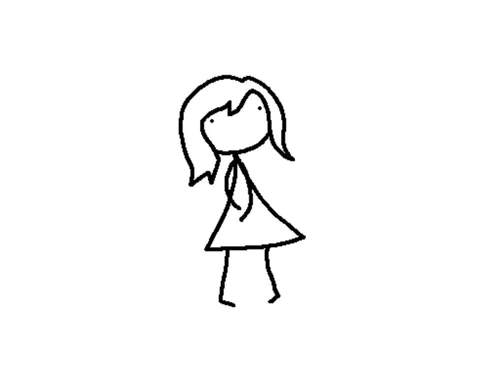
The drawing has several dates and names
The drawing is simple to the extreme: a rounded head, two dot eyes, a smile and an unfinished linear figure. In 2014 the video blogger Agniya Ogonyok retold a story in which the author of Dib was named as Egor Sitnikov. According to that version, he drew and distributed the little figure and then created a community around it. Sitnikov later clarified that he had found the drawing itself in the comments and claimed it as his own, but he did help make the character a meme and released its variations.
There is also an earlier trace: an archival post from the community “Memchiki i smeshnye kvadraty” dated August 19, 2012 shows a similar little figure in a comic. This pushes the well-known drawing back at least two years and does not allow us to name the author of the original picture with confidence. The popularization can be dated more cautiously: by 2014 Dib was already circulating as a character with captions and parodies. The drawing and the wave of its fame are different events.
How the nickname attached itself to the character
“Dib” is written with a lowercase letter; people remembered it as “khlebushek” from the caption “IQ like a little bread.” The name “terebonka” appeared later and is tied to a colloquial Russian verb with a sexual meaning. This is not an action shown in the picture: the character simply stands and smiles. The word moved into captions and gradually became one of the names of the little figure itself.
When the figure appeared in communities and on Pikabu, drawings, short phrases and comics appeared alongside it. Some jokes played on the slightly crude meaning of the word, while others used Dib simply as a ridiculously pleased interlocutor. In 2017 the community “dib i evo druzya” stopped updating, but that is the date when this particular group faded, not the disappearance of all variations from the internet.
A smile without a stated reason
In this version there is no object, scene or line that would explain the expression. So the caption has to supply the reason itself: the little figure may be absurdly pleased after a small success, look at an incomprehensible instruction, or say something everyday and silly. The drawing does not tell us that the hero is actually foolish or doing anything specific; only the text assigns such roles.
Invented example: “Opened the schedule, and there’s exactly one free evening, mine.” The smile turns ordinary relief into naive triumph. Another invented variant: the caption “I’ve got it all figured out” sits next to a task in which the character immediately confuses Tuesday with Thursday. The humor comes not from detailed drawing but from the mismatch between the confident simplicity of the face and the bewildered statement.
What can be inherited from the old wave
In their own community, Sitnikov and his team released not only individual drawings but also versions of Dib in the guise of characters from series, games and films. His later account also mentions amateur films and games made by participants. So the simple face became not a single picture with a fixed meaning, but a convenient shell for a whole set of parodies and local jokes.
This story explains why different names and intonations occur today: one user recognizes “khlebushek,” another Dib, and a third the crude-sounding “terebonka.” An invented variant with an alarm clock or a forgotten password can use only the smile and the simple shape; it does not have to repeat the sexual meaning of the nickname. The main difference between versions is often not the drawing but the word that was attached to the figure and fixed to it within the community.