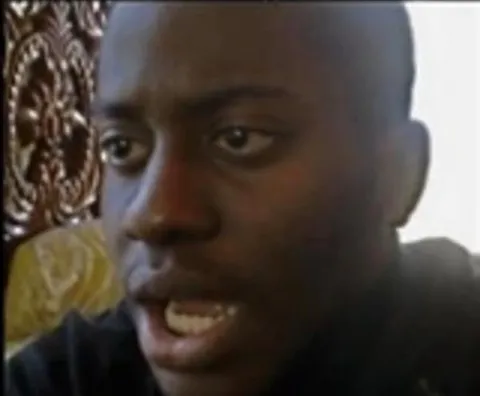
A scene from a film, not an invented sound
The frame comes from “Azonto Ghost,” a Ghanaian film in the Twi language released in 2012. In 2018, the director and screenwriter Scilla Owusu explained the scene to journalists: the wife is embarrassed to tell her husband that she is three months pregnant, and he first persuades her to share the news, after which he rejoices and thanks God. So the exaggerated reaction inside the film is relief and happiness, not sarcasm.
By March 13, 2018, the phrase and image were already appearing in feeds; a contemporary note said the meme had been circulating for at least a week. This points to rapid spread in the spring, but not to one established starting point. Several years passed between the 2012 film and the online wave.
How the open mouth changes its meaning
In the frame, the face fills almost the entire rectangle. The eyes point upward and the mouth is wide open; the background and clothing do not distract from the expression. In the film it accompanies good news, so a short caption is easily read as a sincere “wow, look at that.” Outside the plot, the viewer is no longer told what actually happened, and the vivid reaction becomes a universal answer to any surprise.
A clarification changes the tone. If the news is genuinely pleasant, the picture shows unrestrained joy. If the event is minor, inconvenient or unwelcome, the same delight turns into irony: the face speaks louder than the situation. This is not necessarily mockery of the film character. Usually what is funny is the scale of the reaction that the caption applies to a completely different piece of news.
Context helps tell delight from sarcasm
Invented example: under the frame, “The meeting I was already late for got cancelled.” Here the joy is deliberately excessive: the win is not the cancellation as such, but the saving coincidence. Another invented variant: “Found the lunch container I cooked yesterday in the freezer.” Such a caption keeps the emotion almost literal: a small stroke of luck is shown as a big event.
If you write only “wow,” the reader has to find the reason on their own, and the scene may be left without a joke. A concrete piece of news sets up the contrast. For example, an announcement that the queue has moved up one place can be presented as an astonishing achievement, and a free seat by the window as a rare victory. These captions are invented; they show how one and the same facial expression can carry both a sincere and a deliberately inflated reaction.
Why the short phrase outlived the film
In the original line, two short exclamations follow one another: first the hero seems to take in the news, then he intensifies the reaction with the word “Wow.” In meme usage this mini-escalation survives even without the original dialogue. The English version is often left untranslated, while Russian renderings such as “О боже, вау” convey the meaning but sound different and may lose the phrase’s familiar rhythm.
So the caption sometimes does without a full sentence: the picture and a short piece of news supply the occasion, and the quote adds the voice. In another version, you can leave only the frame with a description of the event and let the reader hear the line in their head. In this way the phrase separates from the family scene in the film but keeps its main quality: a suddenly spoken, almost theatrical delight.