A still from the first season of Pokémon
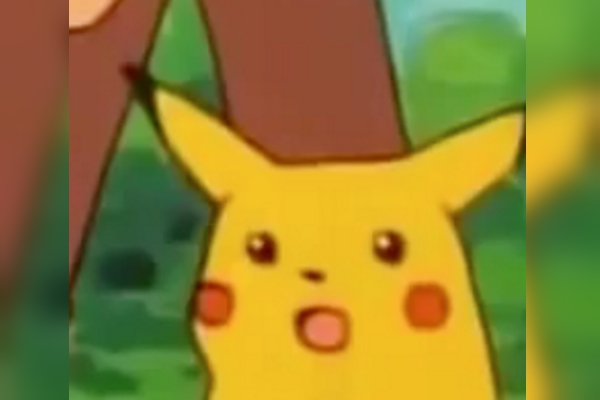
The picture is taken from the tenth episode of the first season of the anime, known in English as “Bulbasaur and the Hidden Village.” In Japan the episode aired on June 3, 1997. Ash and his friends encounter Bulbasaur, who is protecting other Pokémon. During the clash he deflects the sleep-inducing powder of Butterfree, and Pikachu reacts to what is happening.
A separate moment became the meme: round eyes, a small open mouth and an almost motionless face. Fragments of other characters remain around it, but the tight framing makes Pikachu's reaction the center. The image is blurred, with strips of blurred background added at the sides. This is not a modern redraw with crisp outlines, but a recognizable copy of an old animation frame.
A screenshot that came in handy a year later
The meme's creator, Angela, known on Tumblr as popokko, said she saved this frame back in 2017 while rewatching early episodes. She was collecting funny or unusually drawn expressions of Pikachu for a selection; this screenshot stayed in her files and later found its own use.
On September 26, 2018, popokko posted it on Tumblr alongside a joke about an object that is deliberately bent even though one knows it will break. After it breaks, the narrator is still surprised. The image closed a small story: the reader already understands the result, while the character depicts a person who has unexpectedly discovered the obvious. In this way, the specific frame acquired a separate meme meaning.
Autumn 2018: the reaction goes beyond Tumblr
At the end of September and in October 2018, the format appeared in Reddit communities and on other platforms. Users replaced the original situation with their own stories, keeping the same final reaction. What spread was no longer a single joke about a broken object, but a way of talking about a predictable failure.
Popokko herself noticed the change when she saw the picture in replies to Twitter posts, and later on Instagram. Clearer redraws appeared afterward, although the author preferred the rough old version. The name Surprised Pikachu came to describe the expression itself: one can say a person “did a surprised Pikachu” without even attaching the picture.
Why the surprise is already known to the reader
This reaction has a particular intonation. An ordinary surprise picture says: something unexpected happened. Pikachu often says the opposite: exactly what had to happen happened, but the character somehow expected an exception. The gap between the viewer's knowledge and the narrator's expectation creates the joke.
That is why the format is handy for self-irony. One can recall their own decision not to charge the phone, to postpone preparation, or to ignore instructions. Pikachu depicts a reaction to the result rather than blaming another person. If the frame is attached to genuinely unexpected news, it will also be understood, but the tone of predictability is set precisely by the text.
Captions about predictable consequences
The following examples were invented for this article; they are not captions from the original publication.
“Set the alarm for six. Went to bed at five. Now I want to sleep in the morning.” Pikachu completes a situation in which the arithmetic was clear even before going to bed.
“Left the last piece of cake in the shared kitchen. Came back in the evening: no last piece.” Here the surprise contradicts the conditions the narrator created himself.
“Closed the document without saving to leave faster. Now the document is unsaved.” The formal repetition turns a familiar mistake into a small story about a miracle that didn't happen.