An alien studies Earth's nature
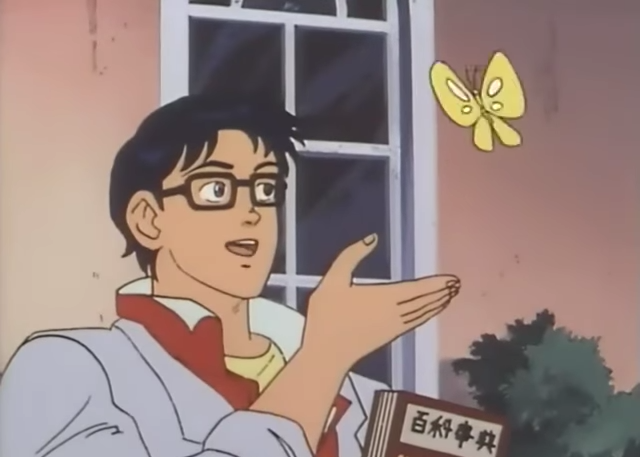
The scene is taken from the third episode of The Brave Fighter of Sun Fighbird, a Sunrise series that began in 1991. Yutaro Katori looks like a young man in glasses, but behind that appearance stands an alien using an android body. He defends Earth and at the same time gets acquainted with a world he still understands poorly. The naive question about the butterfly fits this newcomer's position.
Katori really does ask whether the creature in front of him is a pigeon. The English subtitles did not spoil the obvious name of the insect: the mistake belongs to the character. This matters for the scene's comic character. He is not playing with his conversation partner or trying to deceive the viewer on purpose; he openly reveals a gap in his knowledge of something everyone knows.
The screenshot turned out older than the big wave
The known early trace of the image on Tumblr dates to December 2011. It was shared as an unexpected line from an anime and was sometimes mistakenly included in collections of bad translations. Over time the single funny frame acquired a different structure: captions began to ask who exactly is looking and what exactly is being wrongly named.
In spring 2018 this structure got a noticeable new wave on Twitter and Reddit. The twenty-year gap between the series and the early spread did not get in the way of the joke: reading a single question did not require watching all of Fighbird. The later reuse also added the ability to talk about modern habits through the old animated newcomer.
Palm, book, and the yellow butterfly
This image has no English subtitle. Katori stands on the left, turns his palm toward the yellow butterfly at the upper right, and holds a book with Japanese characters. Behind him are a window and a bush. Because of the raised eyebrows and open mouth, the gesture reads as a question or an attempt to figure something out. The butterfly is distinct enough that the viewer immediately tells it apart from a bird.
A caption on the person usually assigns the observer, a caption on the butterfly the object being observed, and the question at the bottom the category the observer has chosen. These three roles do not match in knowledge: the reader already understands the answer and watches the character draw the wrong conclusion. The book adds a funny appearance of preparedness. The hero has the information, but applies it in the wrong place.
The mistake can be naive or convenient
The format has two different shades. In one, a person honestly confuses similar things, like a beginner in an unfamiliar activity. In the other, he calls the thing by a word that suits him, despite obvious signs. The same gesture can show both ignorance and self-deception. The specific caption decides whether we are laughing at a lack of experience or at a stubborn wish to see what one wants to see.
New questions for the familiar butterfly
In an imagined variant the person is captioned “Me after buying one packet of seeds,” the butterfly “Three pots on the windowsill,” and the question is “Is this my own farm?” He is not confusing plants with something else: he exaggerates the size of his holdings, wanting to count himself an experienced gardener already.
Another variant shows a novice film buff in front of the end credits: the butterfly labels the director's surname, and the person is the viewer who takes any familiar actor for the film's author. The question “Is this the one who played the lead?” returns the format to a beginner's sincere mistake.
In a third example, a music school student looks at seven saved video lessons and asks: “Is this already the rehearsal?” Here the caption distinguishes gathering materials from the activity itself. The viewer recognizes their own habit and understands the substitution before the hero has a chance to open the first video.