What's visible in the frame
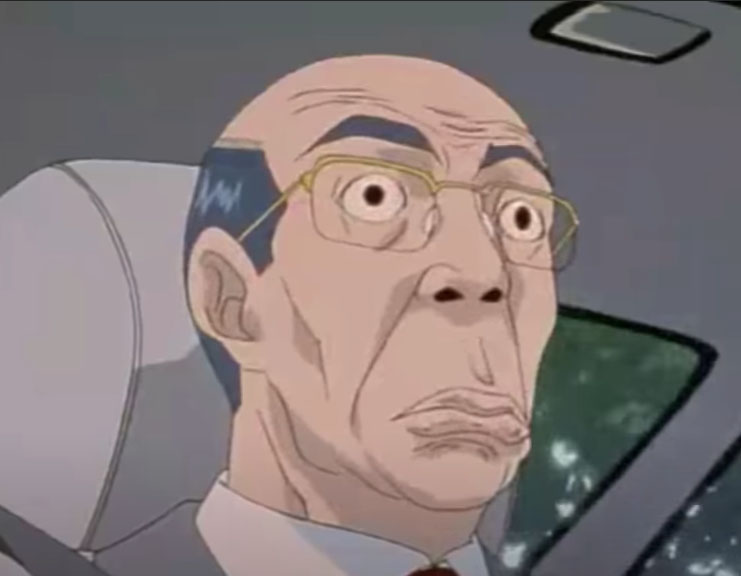
The face takes up almost the entire screen: a bald head with dark eyebrows and a graying strand of hair at the temple, thin gold-rimmed glasses, round eyes with small pupils. The nose has wide nostrils, and the lips are stretched and pressed together, like someone holding their breath. Behind him, a gray car seat, a seatbelt, and a piece of window with greenery beyond it are visible.
The drawing is done in the style of anime from the turn of the 1990s into the 2000s: the outlines are simple, the shading is flat, and the facial expression is deliberately exaggerated. It's precisely this grotesqueness that makes the frame instantly readable, even without knowing what's happening outside the frame.
Which episode it's from
The character is Hiroshi Uchiyamada from the anime "Great Teacher Onizuka" (often referred to by its English abbreviation GTO), the story of a former delinquent who becomes a schoolteacher. Uchiyamada works at the school where the protagonist teaches. According to reports, the scene appears in episode 18, which aired in Japan on January 23, 2000.
The animation itself is brief: in motion, you can see the relaxed look drain away and that same frozen expression take its place. In the static version, as here, only the final phase remains — the peak of realization. The exact episode numbering may differ between countries and releases.
How the frame became a reaction image
As a standalone GIF, this scene reportedly circulated in English-language communities for several years before 2020; the exact dates of the first posts vary, and none of them can be called definitively "the first."
The frame became a mass meme, by most accounts, in 2020, when people started captioning it on social media. It took on a new role: a short reaction that could be dropped into any joke about belated dread.
The mechanics of the joke
The meme's meaning lies in the gap between the composed exterior and the inner panic. The man in the car is going about his usual business, nobody around him notices a thing, but a thought that can't be undone has already flashed through his mind. So the jokes are usually built on small things that turn into a tragedy precisely because they're remembered too late.
It also matters that the character doesn't scream or bang his head on the wheel. He freezes. Quiet shock is funnier than loud shock, because the viewer fills in everything that happens next on their own.
Example captions
"When you've already driven away from home and remembered that you think you left the iron on." Everyday anxiety is doing the work here: the situation is familiar to almost everyone, and the inability to check right away makes the pause especially agonizing.
"Sent the message, and only then saw exactly who I sent it to." The meme highlights the moment when there's no taking it back, and the face in the frame becomes the face of whoever's making the joke.
"Twenty minutes into the meeting: wait, the camera's on." The contrast between the formal setting and the instant disaster heightens the effect.
"Told my boss 'same to you' when he wished me a nice vacation — and he's leaving tomorrow." The absurdity of the line shows that it's exactly this kind of realized mistake that triggers such a reaction.
How to use the template
It's best to place the caption above or below without covering the face: all the expressiveness is in the eyes and lips. The formula "when you remembered that..." works best, but you can also just describe the situation with no lead-in phrase. The more specific and small the detail, the funnier it is, because general phrases like "when everything's bad" don't create the needed moment of recognition.
The meme suits stories about everyday absentmindedness well. For genuinely serious incidents, it looks out of place, so for jokes about real misfortunes it's better to pick a different template.