The frame and its palette
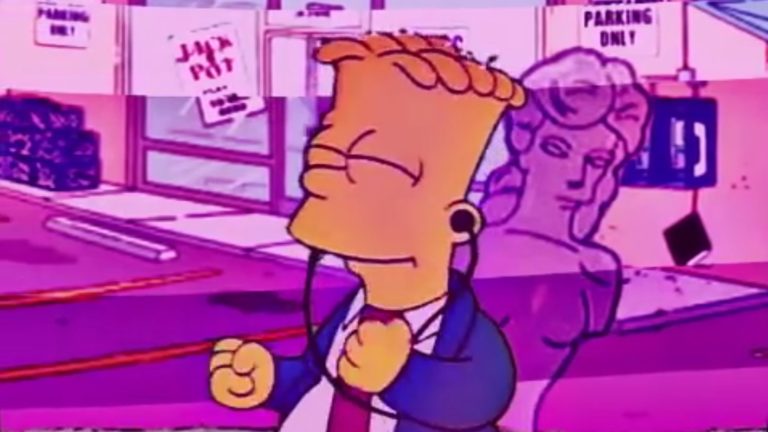
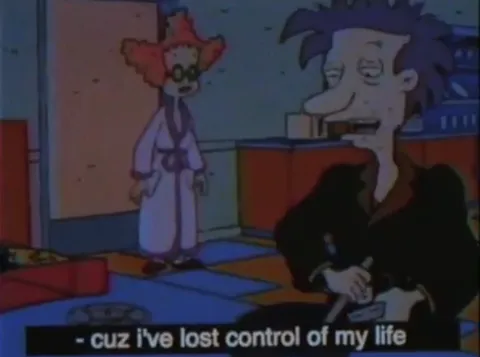
The frame shows a cartoon character in profile: he has spiky hair pointing up, a blue jacket, a red tie, and closed eyes, with his fists pressed to his chest. An earphone wire runs from his ear. The whole image is tinted pink-purple, and behind him one can see a semi-transparent statue of a woman's head, a poster reading "JACKPOT," and signs saying "PARKING ONLY." The upper part of the frame is slightly shifted, as in a digital glitch.
The character resembles Bart Simpson, but the exact episode the frame is taken from has not been established. So nothing can be claimed about the origin of this particular frame: only what is listed above is visible.
The first videos and the 2015 date
According to reviews of the genre, the first known video was posted by a Vine user with the handle Spicster on October 27, 2015. It was a six-second clip in which a fragment of the seventh season of "The Simpsons," episode twenty, "Bart on the Road," was accompanied by the track "Resonance" by the group HOME. The clip gathered more than 21 million views.
Then similar works began to be uploaded to YouTube as well. Long clips that collected millions of views brought the genre wide recognition in 2016. Which re-uploads appeared first has not been reliably determined, so the dates of the early clips are best treated as a rough guide.
Why it works: nostalgia and tempo
The genre relies on two devices. The first is a slow tempo and synth chords that make familiar scenes drawn-out and a little unsettling. The second is the pink-purple palette, which turns a cheerful cartoon into a memory, seen as if through glass.
It's funny and sad at the same time: scenes that seemed simple in childhood look empty and detached in a new context. It is precisely the gap between the cheerful source and the melancholy music that makes these clips recognizable from the first seconds.
Caption examples and text in the videos
Captions in this genre usually appear inside the clip or in its title. Below are three invented examples.
"Childhood slowed down to a single synth chord." The caption names the genre's device itself: a familiar scene drags on like film played at half speed.
"A 90s cartoon recolored into a sunset that never existed in it." The pink-purple filter and childhood nostalgia connect directly: a familiar frame from childhood unexpectedly gets a color and mood that were certainly not in the original episode.
"Parking only for those who remember this episode." The sign from the frame turns into a joke for insiders: it works for those who recognize the episode, and so it feels intimate.
What the genre looks like today
The genre spread through repetition: short loops collected views, were re-uploaded, and picked up by other creators. That's why the Vine version and the YouTube clips that appeared soon after are different stages of one process.
The template is easy to recognize: any frame from a familiar series, a light color shift, digital noise such as a displaced strip of the frame, and slow music under which the picture seems to drift. One short phrase is enough for a caption, because the color of the frame and a track like the very "Resonance" under which the first video spread already set the mood: extra words here only dilute the effect.