A song with many versions
The chorus is linked to the Brazilian song “Bara Bará Bere Berê”. It was performed by various artists, including Alex Ferrari and Michel Teló. Versions were recorded later as well, so online they were often confused, and one performer was credited with what belonged to another.
Wide recognition in Europe came around 2012: the song played in clubs and on the radio in several countries. Exact release dates, chart positions and details about the lyricist are not confirmed, so they are not given here.
This is the story of the song itself. The picture with the figures appeared later, and its date cannot be linked to the hit: when the template appeared remains unestablished.
What the picture shows
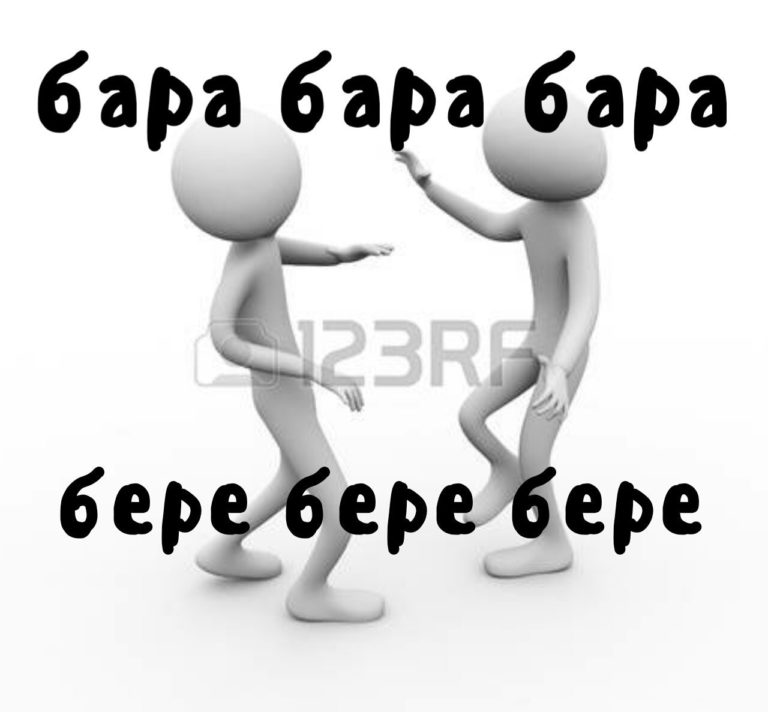
The image shows two smooth gray 3D figures without faces or clothes. The left one stands, pushes an open palm forward and slightly bends its knees. The right one raises an arm above its head and leans to the side, one leg bent. The background is white, with the watermark of a stock photo agency faintly visible in the middle: the template is taken from a library of ready-made images, not from a concert frame.
Above, in large black letters, it says “bara bara bara”; below, “bere bere bere”. Each line consists of three identical words, and the eye reads the top first, then the bottom. The result is a rhythm resembling a chorus, even if no melody plays in your head.
The picture does not show a specific dance from the song. The figures pose, and their gestures cannot be called copies of moves from the video. The captions work at the level of sound: the reader has to hear the rhythm for themselves, while the photo only sets the tone.
Captions that hold on rhythm
Below are invented examples. All of them are built on repetition and a sharp shift of topic, so they are easy to read aloud.
“Monday: bara bara bara. Friday: bere bere bere.” The example works on symmetry: two lines use one rhythm but describe different states of a person. The contrast is visible at once, and the repetition makes the shift noticeable.
“You said ‘I’ll call back.’ Bara bara bara. You didn’t call. Bere bere bere.” The syllables stand in for pauses in a conversation. The repetition creates expectation, and the short ending cuts it off.
“Bara bara — when the chat writes ‘ok.’ Bere bere — when an hour later ‘I’m here’ arrives.” This variant divides roles: the first line describes a quick reaction, the second a delay. Such a pair works better than a long text, because the reader fills in the difference themselves.
The general principle is one: the text is short, the repetition is noticeable, and the meaning appears in the last line. If a caption runs longer than four to five words per line, the rhythm is lost.
When the template fits
The template suits short reactions where rhythm matters more than exact meaning: a reply to a long queue, a response to a long wait, or a comment on an awkward pause. It works poorly when a caption tries to explain everything, because the repetition loses force after two or three lines.
It is important not to confuse the joke with the song. The text does not explain the melody or translate the words: it relies on a familiar sound image, and the meaninglessness of the syllables is the joke itself. If the reader doesn’t know the song, the caption still reads as wordplay, and that is a working option too.