What's shown in the image
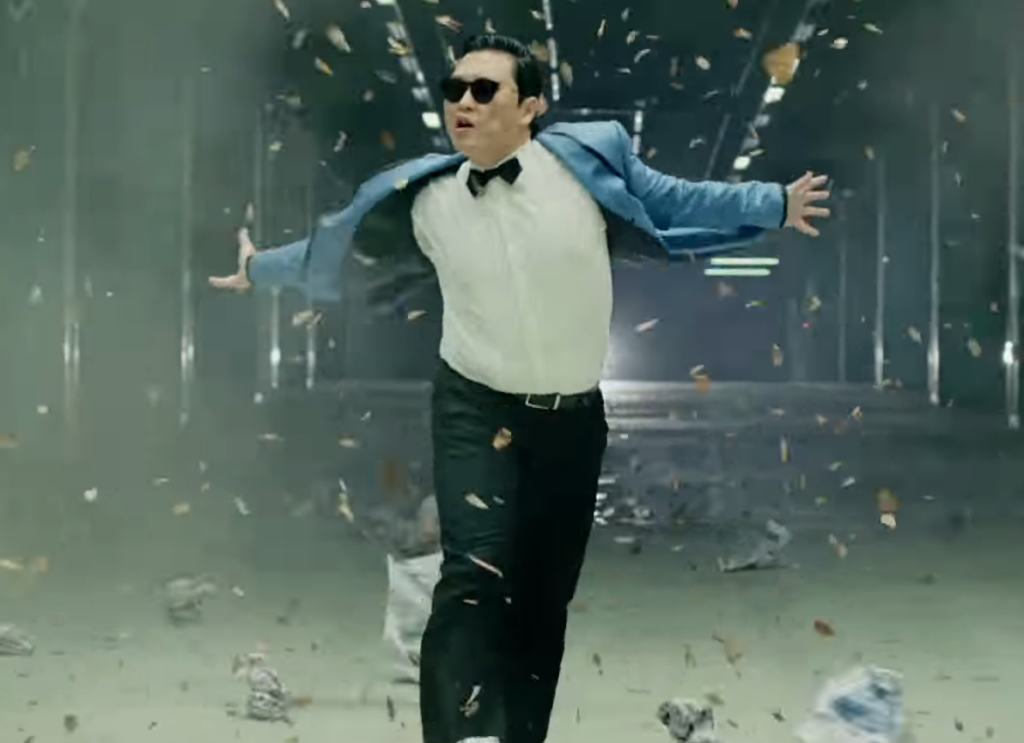
In a still from the video, PSY stands in the middle of a spacious concrete hall. He's wearing the look that became attached to him: a light blue jacket, a white shirt, a black bow tie, and dark sunglasses. His arms are spread to the sides, his jacket flares slightly, and scraps of paper and litter are scattered across the floor and in the air around him. The shot looks deliberately pompous: the performer seems to be stepping onto a stage to applause, even though the space around him is empty and run-down.
The contrast between the serious pose and the absurd setting became the video's visual foundation. The still is recognizable by the costume and gesture alone, without a caption. That's why it's often used as a reaction image about showing off success, trying to look more important than one actually is, or sudden triumph over any occasion, even a trivial one.
How it was created
The track came out on July 15, 2012. PSY had been known in South Korea since the late 2000s, but worldwide success came specifically with this single. The title refers to Gangnam, a prestigious business and shopping district of Seoul that in the public imagination is associated with wealth, brands, and the pursuit of status. The song's lyrics mock this lifestyle: the hero lives for show, loves expensive cars, and wants to seem sophisticated, even though he actually behaves rather ridiculously.
It's important that this is satire, not praise. However, Western audiences often took the video at face value, as a fun dance song, and many heard the English-language hook "Oppa Gangnam style" as a meaningless string of words. The language barrier didn't get in the way — if anything it helped: the music and visuals turned out to be understandable without translating the lyrics.
The dance and parodies
The video's central element was the dance, called "malchum" (말춤), or "horse dance," in Korea. The movements mimic riding a horse: the performer bounces sharply, waves his arms as if holding reins, and makes characteristic lean-backs. The dance is easy to repeat, so people quickly picked it up at parties, in schools, at offices, and at sporting events.
Dozens, and then hundreds, of parodies soon appeared. Athletes, soldiers, politicians, office workers, police officers, animals, and cartoon characters all danced in them. These clips were often filmed as a joke, and each participant added something of their own, so the meme quickly turned from a specific video into a universal format. PSY himself performed on American television and at public events, doing the dance live.
Records and recognition
On December 21, 2012, the video became the first on YouTube to reach a billion views. For the platform's early era, that was a major event: no clip of that scale had ever gathered that many views before. Later the view count passed five billion, and Gangnam Style remained for a long time one of the site's most-watched videos.
The song charted in many countries and brought the performer international fame. Critics noted that the success rested not so much on musical novelty as on the combination of a vivid image, an easy-to-repeat dance, and the internet's viral nature, which let the clips spread quickly through social networks and blogs.
Why the meme works
The joke's mechanics work on several levels. The first is absurdity: a serious delivery combined with a ridiculous dance in an empty hall. The second is self-irony: the performer himself plays the role of a self-absorbed hero, and the viewer sees that he's laughing at this image along with everyone else. The third is how easy it is to copy: anyone can reproduce the moves in half a minute.
In casual speech, the phrase "gangnam style" is usually used when someone is showing off ostentatiously or doing something with a deliberately important air. The phrase can be used without the dance too. PSY's image in sunglasses with arms spread remains recognizable years later and has become one of the symbols of 2010s internet culture.