What can be seen in the frame
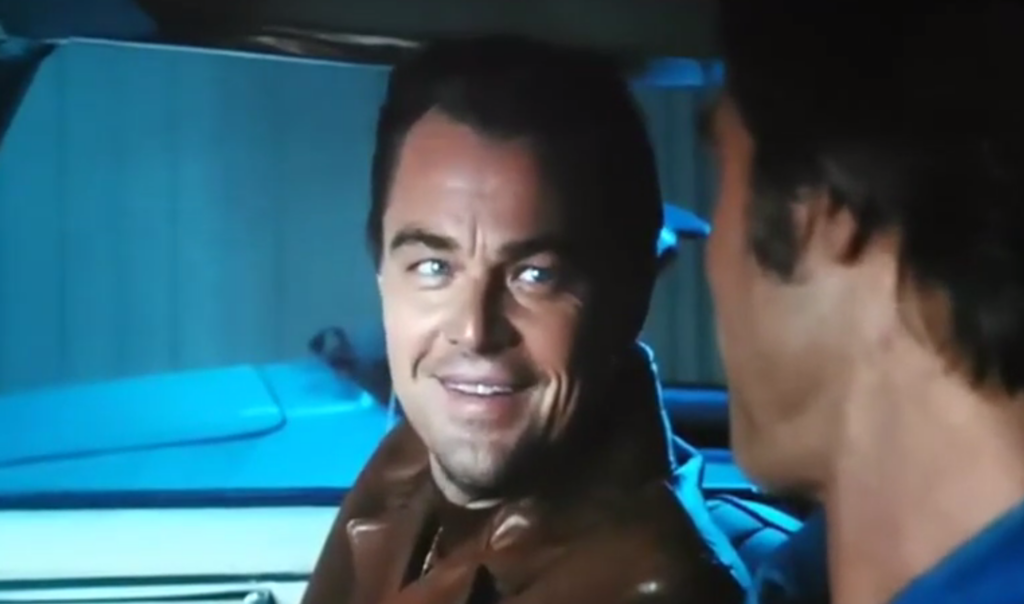
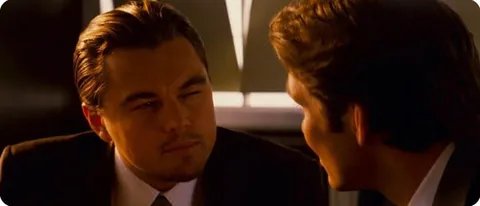
The frame is grainy, shot under night lighting with a cold blue tint. In the center, in close-up, is a man in a shiny brown jacket: he has turned his head slightly and is smiling, eyes slightly narrowed, gaze directed at his interlocutor. On the right foreground can be seen the back of the head and part of the face of a second person, making the frame look like a hushed, low-voiced conversation. Behind on the left a light surface can be made out, possibly part of a car, but this cannot be determined from a single screenshot.
The main thing in this image is perhaps not the setting but the facial expression. The smile is at once friendly and slightly sly, like a person who has just come up with a very bad but very exciting idea. It is exactly this combination that proved useful for the joke.
The film and its hero
“Once Upon a Time… in Hollywood” is Quentin Tarantino’s ninth film. It premiered at the Cannes Film Festival on May 21, 2019, and was released in American cinemas on July 26, 2019. The action takes place in Los Angeles in 1969. Leonardo DiCaprio plays Rick Dalton, an actor whose fame as a television cowboy is in the past, and beside him works his stunt double Cliff Booth, played by Brad Pitt.
In the late part of the film, an attack occurs at Rick’s house, and Rick takes a flamethrower from the shed and uses it to dispatch the unwelcome female intruder. The episode stuck with viewers for its unexpected brutality and black humor: a hero who has seemed unsure and vulnerable all through the film suddenly acts decisively and very spectacularly.
How the joke works
The meme barely retells the plot; it takes from it a single image: the flamethrower as a wildly disproportionate tool. If you caption the frame with an everyday annoyance, a comic gap opens between the scale of the problem and the scale of the response. The smaller the trigger, the funnier it is: after all, nobody is actually going to set anything on fire, and anger at a neighbor with a drill or a frozen printer finds expression in a safe way.
The second half of the effect is the smile. The hero does not shout or get angry; he speaks calmly and even cheerfully. This turns the phrase from a threat into a joke about anticipation: a person almost gleefully foresees how they will deal with the problem. When the first jokes using this frame appeared is not established here, but their mechanics are shared and easily recognized.
Examples for your own caption
“The neighbor started drilling the wall at seven on a Saturday morning.” The caption “I’m going for the flamethrower” turns a familiar irritation into comic readiness for extreme measures. The contrast between an everyday situation and a weapon from the movies does the work.
“A colleague replied to everyone in the work chat for the fifth time.” Work trifles gain from exaggeration: nobody disputes that a reply-all is annoying, but the flamethrower makes the irritation harmless.
“The landlord wrote that he’ll stop by tomorrow to check the tap.” Here the meme shows an anxious rather than angry mood: the hero in the frame is ready for anything, unlike the author of the caption.
“A friend said: let’s assemble the wardrobe without the instructions.” The hero’s smile reads as “I’ve already figured it all out,” though this promises nothing good.
Tips for use
Captions are best built on minor everyday triggers and on comic readiness, rather than on real hostility toward specific people: the flamethrower joke is good precisely because it stays entirely unreal. A short formula, “situation + me,” reads instantly; long explanations only break the pause.
If you want a version without the rough words, it is enough to keep the phrase “I’m going for the flamethrower.” The frame itself suggests the intonation: relaxed and contented.