What is in the frame
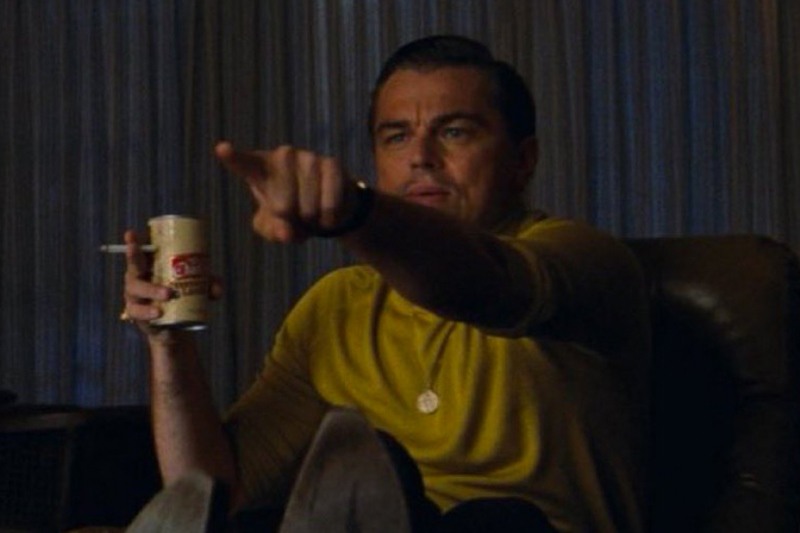
In a dimly lit room behind a dark curtain, a man in a yellow sweater with a pendant on his neck sits in a leather armchair. In his left hand he holds a can of beer and a cigarette; his right arm is extended forward, index finger pointing at something outside the frame. His face is tense, his brows are drawn together, and his gaze is focused.
The character is Rick Dalton, an aging Western star played by Leonardo DiCaprio. The emotion is both eager and childishly joyful, which is why other people's situations attach to it so easily.
The scene in the film
Tarantino's film came out in 2019: it premiered at Cannes in May, and it reached American theaters on July 26. According to descriptions of the scene, Rick is watching television at home, where an episode of the series 'F.B.I.' is airing, in which he played a role. Recognizing himself on screen, he jabs a finger at the TV.
Sources differ only in minor details, but the essence is the same everywhere: the hero notices himself in the frame. It is precisely this situation of recognition that gave the meme its meaning, rather than an abstract 'noticed a mistake'. That is why early jokes most often featured 'recognized something familiar'.
How the frame became a meme
The first known use is dated February 7, 2020, when a Twitter user captioned the frame with a joke about the timeline in 'Little Women'. The real rise came on April 5, 2020: a tweet reading 'when someone in the movie says the name of the movie' collected hundreds of thousands of likes. After that the template spread across all platforms.
The secret of its success is that the caption describes a universal feeling: the pleasure of having noticed or recognized something. You do not need to know the film for this: the pose is enough, and you may not know the name of the scene at all.
The meme has kept the habit of living on for years: it comes back every time a new film with an 'Easter egg' comes out or a familiar actor appears in a series. Thanks to this, the template has no single topic; it belongs to all fandoms at once and works equally well in discussions of film, music, games and everyday observations. An additional plus is that the frame is easy to read even at a small size, for example in comment previews.
Mechanics of the joke
The joke is built on recognition: the caption names the event ('an actor from a past film in a bit part'), and the hero's finger confirms it: 'there it is.' A small detail works well: the more trivial the occasion, the funnier the seriousness of the face.
A second way to play with it is self-irony. A person captions the frame with their own weakness and shows that they 'noticed' it: it is comical when the triumph is tied to a trifle.
Caption examples
'When I found a familiar cat in someone else's building entrance.' Everyday recognition, addressed to the viewer.
'Me, when I finally noticed in the chat that the date shows the wrong year.' Self-irony: the triumph of someone resourceful but late.
'When during a break in the series I saw a prop from my favorite film.' A movie-themed version for lovers of details.
'When I heard a familiar sample in a song.' Works well in music communities.
How to use the template
Use the frame when you want to express the joy of recognition, not anger or accusation: this is what sets it apart from other 'pointing' pictures. It is better to write the caption in the form 'when...' and limit it to one situation.
Be careful with spoilers: if you point to a plot detail, warn the reader.