What the picture shows
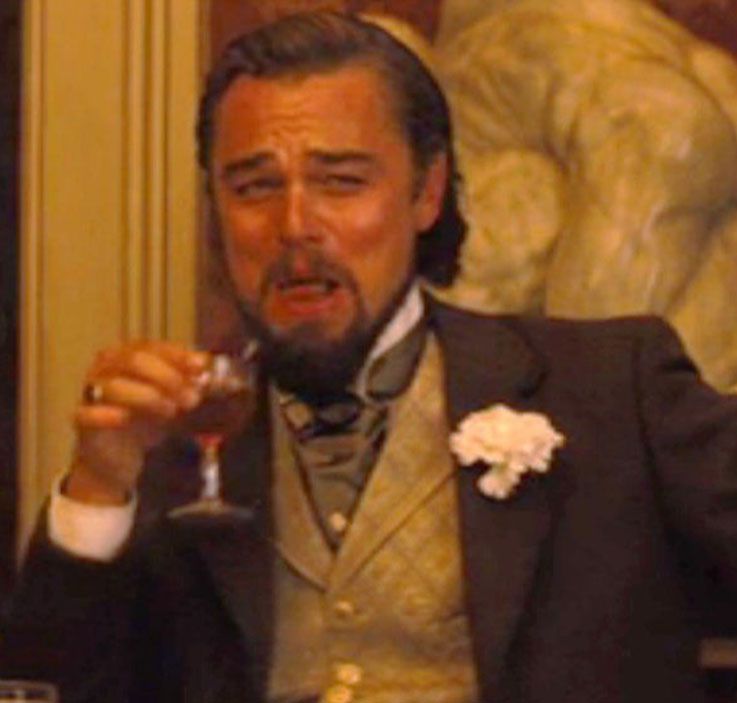
A close-up of a man with a neat beard and dark hair combed back. He is grimacing hard, one eye squeezed shut and lips stretched: it could be laughter or a wince. In his raised hand is a glass of red drink on a thin stem, and there is a ring on his finger. He wears a brown frock coat, a light patterned waistcoat, a cravat, and a white flower in his buttonhole. The background is warm-toned.
The face and pose look like the laughter of a person who cannot hold back but is slightly contemptuous of the other person. That ambiguity is what makes the frame so versatile.
Where the frame comes from
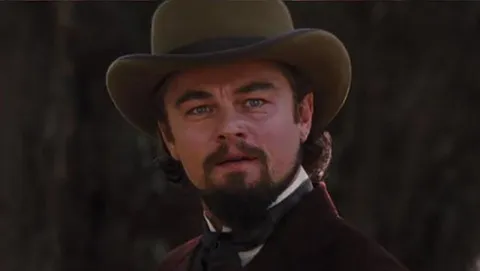
Django Unchained came out in 2012, directed by Quentin Tarantino. DiCaprio plays Calvin Candie, a plantation owner and one of the film’s main antagonists. In memes the character and the scene’s context barely matter, so the emotion is detached from the plot.
According to meme databases, an early known version with this frame appeared on Tumblr in November 2017, where a drink was added to the image. The template gained broad popularity in 2020: in January a Reddit user posted a version with an upside-down dessert glass, and by August posts with the frame were collecting tens of thousands of upvotes in meme communities.
How the meme works
The caption explains what the character is laughing at. Most often it is someone’s self-assurance, a flawed plan, or an obvious lie: “yeah, sure.” The laugh reads as a reaction to a situation where everything went exactly as it was always going to.
The frame also fits when a person laughs at themselves. You just need to watch what exactly the mockery is aimed at: the film’s character looks cruel, so nasty jokes about real people come across as harsher than intended.
Note that the laugh has no sound here, and that matters: the viewer fills it in mentally, so each person hears their own version, from a quiet snicker to a loud guffaw. Such an unspecified sound makes the frame flexible: in one caption it is gloating, in another good-natured.
Example captions
“Friend: I’m definitely starting to run this week. Me, knowing he says it every Monday.” The laugh conveys knowledge of a pattern.
“Boss: we’re one big happy family.” A caption with no reply, whose laughter reads as commentary.
“My plan to get up at six in the morning.” Here Candie laughs at his own plan, and the joke becomes self-irony.
“Store: up to 70% off. Discount: 3% off one item.” The joke relies on the gap between advertising and reality.
How to use the template
It works best to caption the reason for laughter rather than the character: “when I heard…” or “me, when…”. Long captions hurt here, since the facial expression already says it all.
Use the frame where people laugh at a situation or at themselves, and avoid it in response to someone else’s misfortune. The laugh on this face is easily read as mockery.
This frame also pairs well with two-part templates: on the left, the words of an overconfident conversation partner, on the right, Candie’s reaction. The key is that the words should be plausible but still raise doubt. Then the viewer “hears” how that laugh sounds, and the caption needs no explanation.