Movie hysteria turned into a short question
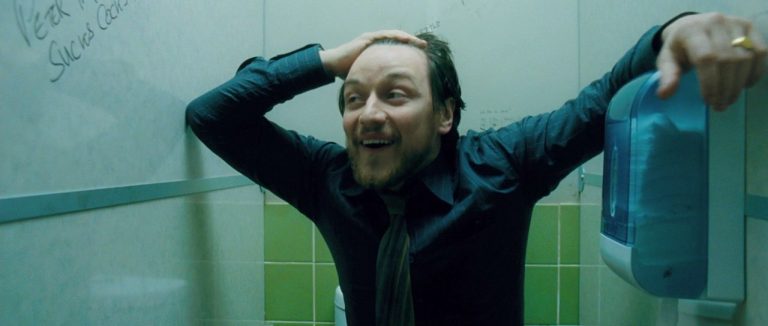
The film Filth, known in Russian as “Gryaz” (“Dirt”), came out in 2013. It was directed and written by Jon S. Baird, and its lead role was played by James McAvoy. Bruce Robertson is a police officer whose story combines savage satire, abuse of power and his own destructive behavior. His violent reactions belong to the world of black comedy, where the funny constantly sits alongside the unpleasant.
The meme uses a moment in a bathroom: the character laughs and looks as if he cannot cope with what is happening. The frame appears in an early online trail from 2016, while the notable Russian-language wave is tied to February 2018. At that time it spread with a crude exclamation and the question of what is actually going on. Later the image was used in templates and new captions. The gap between the film’s release and the meme wave explains why the reaction could feel familiar to people who never watched the movie itself.
A smile, a palm on the head and a blue dryer
In the image, McAvoy wears a dark shirt. One of his hands rests on the top of his head, and the other reaches toward a blue wall-mounted hand dryer on the right. His mouth is open, his eyes stare wide ahead, and his face suggests a mix of laughter and astonishment. Behind him are pale walls with a green strip of tiles; a sign on the wall is visible in the upper left corner.
The file itself contains no ready-made meme phrase. It is a single wide frame in which the gesture and facial expression hold the reaction without any sequence of actions. The palm on the head creates a familiar feeling of overload, while the outstretched arm makes the pose looser and more theatrical. The dryer and tiles preserve a specific cinematic setting, although a caption can easily shift the viewer’s attention to someone else’s news or an everyday story.
When explanation falls behind events
This reaction differs from an ordinary surprised portrait in its ambiguity. The character does not simply notice something unexpected: he looks as if he is simultaneously laughing at it and ceasing to understand the rules of the situation. That is why the frame fits an absurd chain of events in which each next step makes the previous one even less clear. The question in the caption tells us that the observer has already lost the ability to calmly retell what he saw.
The joke often appears after a confident start. A person expected a clear result, opened a message or switched on a device, and instead found several incompatible explanations. McAvoy’s pose depicts the turning point from trying to make sense of things to nervous amusement. A crude version of the caption intensifies the emotional jump, but the device works without it too: it is enough to name the strange event and leave the character in the role of a bewildered witness. He comments on what is happening with his appearance rather than offering a solution.
Three stories with an unexpected twist
In an invented sketch, a person turns on a robot vacuum and receives a notification that it has “returned to base.” The camera shows that the device really did return, but it brought with it a slipper, a long thread and half a curtain. McAvoy’s frame is accompanied by the question: “Was it cleaning or collecting a collection?” An understandable action produces a result incompatible with its goal.
In a second example, friends argue about who brought a board game. One pulls out the rules from one box, another shows the tokens from a third, and the host announces all of it as a new mode. The reaction appears after a confident explanation, once it becomes clear that nobody knows what game the group is actually going to play. The character laughs because the ordinary clarification only increased the confusion.
The third sketch is about a school timetable: a message cancelling a lesson cancels the previous message, which had cancelled the rescheduling of a class. The caption under the frame reads: “I’ve packed my backpack three times now. Now I’m collecting evidence.” The comedy builds on the accumulation of mutually exclusive instructions. Each variant turns the pose from an independent puzzle into a precise reaction to a story whose logic is collapsing right in front of the viewer.