The film and the character
American Psycho came out in 2000. The director was Mary Harron, and the screenplay was based on Bret Easton Ellis's 1991 novel of the same name. The main character is a successful Manhattan banker who, in his free time, holds forth at length about brands, clothes, and restaurants. The film runs on black comedy and satire of 1980s yuppie culture, so the violence in it is presented hyperbolically and serves as a metaphor for emptiness and self-admiration.
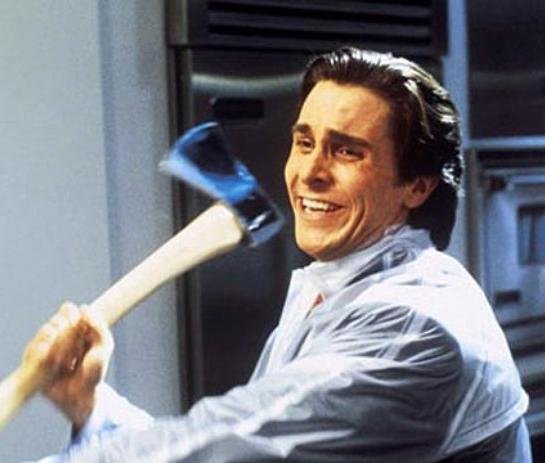
Christian Bale won wide acclaim for the role, and his Bateman became one of the most recognizable characters of the early 2000s. The still with the axe comes from a scene where the character shows an almost childlike glee on his face, and this contrast between his tidy appearance and the brutal scene later became the meme's defining feature.
How the still became a template
The image spread on forums and imageboards during the 2000s and 2010s. The Russian name "Guy with an axe" was fixed in place following the same pattern as other template names: by the main object or action. The exact date it first appeared on the Russian internet, and the author of the first caption, have not been established, so its history has to be reconstructed from how the template was used in comments and discussions.
The key element of the shot is the smile. It makes the emotion ambiguous: the character seems to be enjoying himself, and the viewer reads this as exaggeration rather than as a call to action. Thanks to this, the still combines easily with different captions, and the image itself is read as a symbol of a state of mind rather than an actual deed.
Meaning and typical captions
The template is most often used to describe irritation. Typical captions read something like: "when yet another update broke everything" or "when they ask you to redo the design for the third time." The hyperbole here is obvious: no one actually intends to do anything, the point is an internal state that a person vents through the joke.
The template also shows up in reactions to everyday situations: a line at the store, a slow internet provider, waiting for tech support to reply. The caption almost always sets an ironic tone and doesn't imply any real action, so the meme comes across as self-deprecating humor and doesn't call for serious scrutiny.
Why the joke works
The meme runs on contrast. The character's calm appearance and the sharp gesture create a sense of absurdity. When the caption describes a petty everyday nuisance, the gap between the scale of the reaction and the trigger becomes funny, and that's exactly the device many internet jokes use.
The film has become a cult classic, and its scenes are regularly quoted. A viewer familiar with the movie picks up on the reference faster, while someone who hasn't seen it only needs the gesture itself to grasp the general meaning.
Limits of use
It's important to distinguish the template from real-life situations. The meme is based on a fictional character and a performance, not a real person, so using it in jokes about irritation doesn't imply bullying or a call to violence. Discussions sometimes argue about how appropriate such pictures are for a young audience, and that question remains open.