Who is in the photo
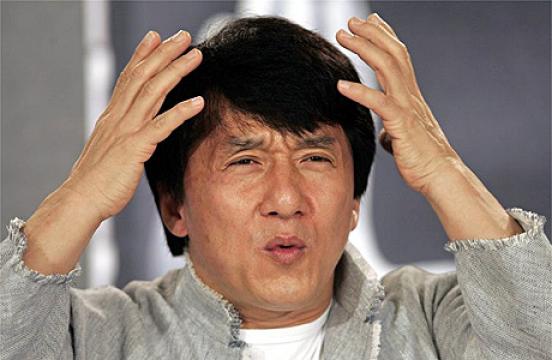
The photo captures Jackie Chan, the Hong Kong actor, stuntman, and martial arts master whose real name is Chan Kong-sang. He is known for the films Drunken Master (1978), Police Story (1985), and the American comedy Rush Hour (1998), made together with Chris Tucker. Chan is famous for performing his own stunts and for being able to blend action with comedy, which is why viewers readily accept him as someone capable of being the first to laugh at his own bewilderment.
In the photo the actor is standing in a gray jacket, clutching his head with both hands, his face expressing confusion with a slight hint of panic. The shot looks like a typical moment from a press conference, when a reporter asked an unexpected question, and it is precisely this spontaneity that made the picture well suited for internet jokes.
Origin of the frame and the meme
The exact date the photo was taken and the author of its first publication are unknown. The image had been circulating online since roughly the late 2000s, and in the Russian-speaking space around 2009 it acquired captions about "mind-blown." It was not possible to determine who first used exactly this angle and caption, so it is better to describe the meme as the result of a natural selection of a good photo rather than a deliberate promotional or authored campaign.
Over time the name became fixed in several variants: "mind-blown," "spectacularly moronic," English captions like WTF, and various profane versions. All of them convey the same feeling, so the variants are easily interchangeable depending on the audience and the level of crudeness desired.
How the meme is used
The picture is most often inserted into comments and discussions of news when an event looks absurd: a complicated law, a ridiculous set of instructions, a strange plot twist in a film, or a pointless exchange with customer support. The caption "my brain" or "mind-blown" instantly makes clear that the author doesn't understand what's going on and isn't trying to hide it.
The meme is also used as a quick reaction in private chats, when someone needs to quickly show that a message came as a surprise. In such cases the picture replaces a long text and works better than any explanation, because the emotion registers instantly.
Why the picture works
The gesture of hands raised to the temples is universal and needs no translation, and the facial expression combines bewilderment, exhaustion, and confusion. This is precisely why the meme is equally understandable across different language environments and isn't tied to any particular event. It preserves the emotion rather than the news, and so it doesn't go stale as quickly as most pictures of its time.
Jackie Chan's image adds another layer to the joke: viewers know him as an actor who constantly ends up in ridiculous situations in his films and comes out of them with humor. Because of this, the meme is taken more as good-natured than mocking, and serves as a reminder that sometimes absurdity just has to be accepted. For many viewers it's also an occasion to recall their own bewildered reactions, when reality turns out more complicated than expected and all one can do is throw up one's hands.