What it shows
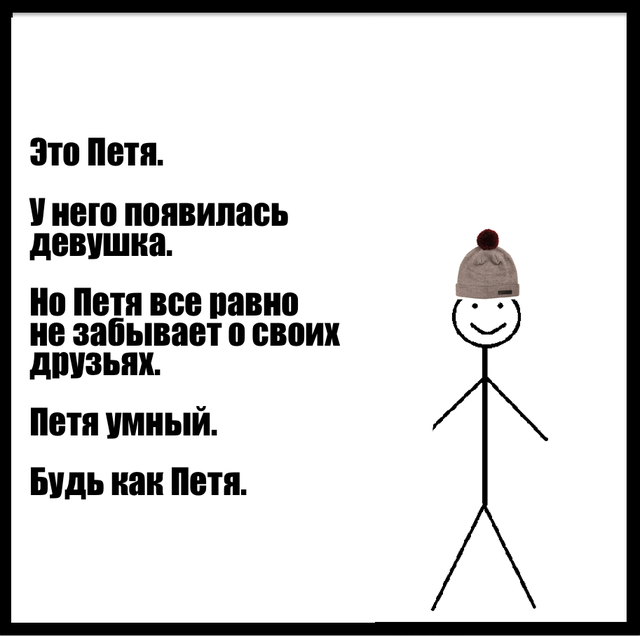
The image is drawn in an extremely simple style: a white background, bold black type, and a stick figure rendered in thin lines. The figure has a round, smiling head topped with a gray knit hat with a pom-pom. Its arms are spread out to the sides and its legs are apart, in an open, friendly pose. The text is arranged in a column and broken into short paragraphs, each describing one more situation.
This minimalism is not accidental. The lack of detail lets any storyline be dropped into the template, while the character himself stays a neutral role model. Petya has no individuality: he embodies abstract "correct" behavior, and the viewer easily maps him onto themselves or onto people they know.
Origin
In January 2016 the meme "Be Like Bill" appeared on the Western internet. Its author is Moldovan internet entrepreneur Eugen Croitoru, who lives in Milan. According to him, the idea is very simple: a person who has some common sense and doesn't do annoying things deserves to be looked up to.
The meme spread rapidly across social networks and was quickly localized: in Arabic the character became Bilal, in Malay he became Rashid, in Spanish he became Jose. In Russia the adaptation was published by Meduza on January 22, 2016, under the headline "This is Petya. Petya is smart. Be like Petya." That title became fixed to the Russian version, and Petya became its hero.
Structure and typical captions
The template is built as a short story with a moral. The first line introduces the character, then comes a description of a situation in which Petya refrains from doing something annoying, or, conversely, does the right thing, followed by the closing line: "Petya is smart. Be like Petya." Thanks to this structure, the template is easy to pick up and extend.
A classic example from the Russian versions: Petya wakes up, sees that it's snowing outside, and doesn't post about it on social media, because he knows his friends have windows too. Other versions describe tactfulness in small things: Petya doesn't retell other people's spoilers, doesn't chew loudly on public transport, and doesn't post photos of his food in the group chat. The humor comes from the deliberate seriousness with which an obvious point is described.
Why the joke works
The meme is built on irony aimed at the motivational-poster genre. Classic motivational posters teach the reader important life principles, often in a grandiose tone. "Be Like Petya" does the same thing, but relies on the trivialities of everyday etiquette, which are funny in themselves. Petya is "smart" not because he performed some feat, but because he refrained from doing something stupid. It's this gap that produces the comedy.
The second reason is simplicity. Creating a new version takes just one line and a minimal drawing, so users join the game easily. The meme quickly turned into a template onto which all sorts of storylines get grafted, from school stories to office life, and the construction works the same way every time.
Place in internet culture
"Be Like Petya" became one of the characteristic examples of Russian-language meme templates that kept their link to the English-language original. The Russian version differs in that it transplants the humor into familiar everyday settings: the courtyard, the office, the group chat. That makes it understandable to an audience with no knowledge of the source material.
The phrase is still used today as an ironic formula when talking about an example to follow in small matters. It shows how a simple format can outlive its initial wave of popularity and stay understandable without any explanation.