What is drawn and how the caption reads
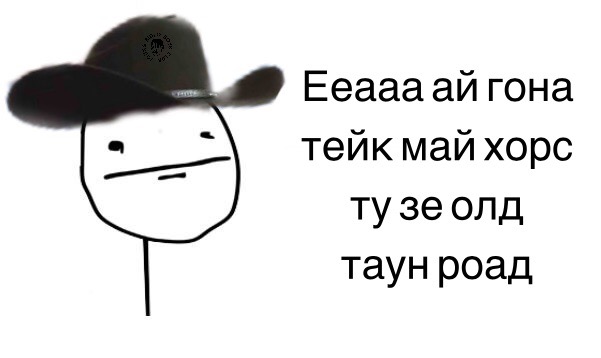
The picture is a simple black-and-white drawing in the style of comic “rage” faces: a round head, a thin line instead of a neck, and a dark cowboy hat with wide brims. The face is almost without expression: short dashes stand in for brows, eyes and mouth, so the expression looks impassive. The character looks straight at the viewer.
On the right, the caption is written in Russian letters across four lines, phonetically spelling out the English lyric: “Yeah, I'm gonna take my horse to the old town road.” It is the opening line of the song, written in Cyrillic as it can be pronounced by ear. The clumsy spelling is itself part of the joke.
The song the line comes from
The song “Old Town Road” by American artist Lil Nas X was released in December 2018 as an independent release. The version featuring Billy Ray Cyrus appeared on April 5, 2019.
In 2019 the track held the top spot on the American Billboard Hot 100 chart for a long stretch: it stayed there 19 weeks in a row, a record result at the time. The song blended country and hip-hop elements, so it quickly reached beyond a single audience, and cowboy aesthetics became a hallmark of internet jokes.
Where the hat comes from
The cowboy hat in this template directly alludes to the song's text and video, where the cowboy image plays the main role. Whether the drawing became attached to a specific author, and when exactly this picture appeared, has not been reliably established.
The Russian transliteration also has no known first author: this device has long been used in jokes where foreign text is written in Cyrillic for comic sound. Here it overlaps with a recognizable hit.
Why the joke works
The main device is the contrast between the energy of the text and the emptiness of the image. The song is full of bravado, while the character expresses nothing but calm indifference. A loud chorus next to an impassive face creates a comic gap.
The second layer is the sound. A line written in Cyrillic is read slowly, syllable by syllable, and the humor lies in the mismatch between how the words look and how they sound. That is why the caption is recognized even by people who don't know the song.
Caption examples
“Yeah, I'm gonna take my horse to the Monday.” The heroic line is moved to an everyday situation, the rhythm is kept, and the destination turns out to be the least romantic one possible.
“Yeah, I'm gonna take my cat to the fridge.” Both the object and the goal are replaced. The sound is recognizable, but the pathos disappears: the hero sets off for food.
“Yeah, I'm gonna take my budget to the old town road.” The financial theme is delivered in the tone of an anthem, and the effect comes from the hero's resolve being caused by a simple lack of money.
Each example changes only part of the line and keeps the rhythm. Recognizability comes from the sound of the line, surprise from the substitution.
How to use the template
The character suits situations where a person resolutely announces something mundane or clearly out of place. The hero's imperturbability makes the caption light, so the template is fitting for irony about one's own decisions.
Do not caption other people's failures or a specific person with it. If the caption gets too long or breaks the rhythm of the original line, recognition disappears and the joke loses its force.