What's drawn
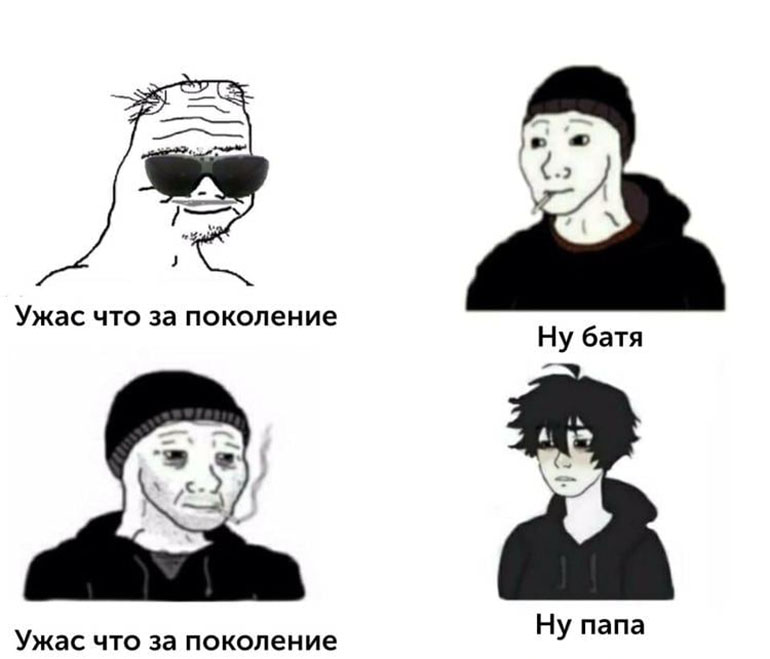
The picture is split into two columns and two rows. In the top-left panel is a drawn elderly man in dark glasses, with stubble and a furrowed brow; below him is the caption "What a terrible generation." To his right is a young guy in a beanie with a cigarette in his mouth, captioned "Yeah, Dad."
In the second row, on the left, is the same character, now in a black beanie and hoodie, aging, with a tired look and a wisp of cigarette smoke, repeating the same line, "What a terrible generation." On the right is a teenager with dark, tousled hair drawn in anime style, wearing a black hoodie, captioned "Yeah, Dad."
The cycle of generations
The plot is simple: each generation condemns the next with the same words. The father despairs over his son, and twenty or thirty years later that son despairs over his own child in turn. The joke is that none of the characters notice they're repeating themselves.
There's also a visual shift. The first three characters are drawn in the style of popular cartoon meme figures, while the last one is drawn in anime style, as if, within the logic of the joke, the world had even changed the way it draws children in that time.
What's known about its origin
The meme is dated to 2020. The author and the first publication aren't named, and no dates are given, so it can't be claimed that the meme appeared on any particular day. All that's known is that the template spread across Russian-language communities in several versions: with the address "daddy," with a different number of panel pairs, and with different captions.
The device itself — generational conflict between parents and children — is older than the internet, and the fact that the meme images simply slotted in modern characters doesn't point to any single source.
Example captions
Invented captions to replace the original text. Top pair: "These smartphones of yours!" — "Yeah, Dad." Second pair: "These neural networks of yours!" — "Yeah, Dad." The trick works because the same complaint is applied to different subjects, and the viewer sees the repetition.
Another variant: "Back in my day we memorized things" — "Yeah, Dad"; "Back in my day we used paper maps" — "Yeah, Dad." Here the nostalgia sounds identical both times, and the joke is that other people's habits always seem strange.
A third variant shifts the frame to family traditions: "Who's that sitting at the table glued to their phone" — "Yeah, Grandma." Swap out the participants and the structure stays the same.
The common thread in all these examples isn't a fresh discovery each time but a recognizable rhythm: the father voices the same complaint, and the son answers with a short "Yeah, Dad." As long as both sides in a given pair of lines look equally ridiculous, the joke holds; make one character clearly right, and the second line turns into an ordinary complaint rather than a caricature of the eternal generational argument.
Tips for using it
The template works well for topics where a shift in tastes and habits is obvious: music, school, work, games. It's best to leave the line "What a terrible generation" unchanged in at least two of the four rows — that repeated phrase is exactly what tells the reader they're looking at the same father-and-son story, not a random set of panels.
Don't turn the captions into attacks on people of a specific age: the joke is meant to poke fun at every generation at once, including whoever's making it.