What the picture shows
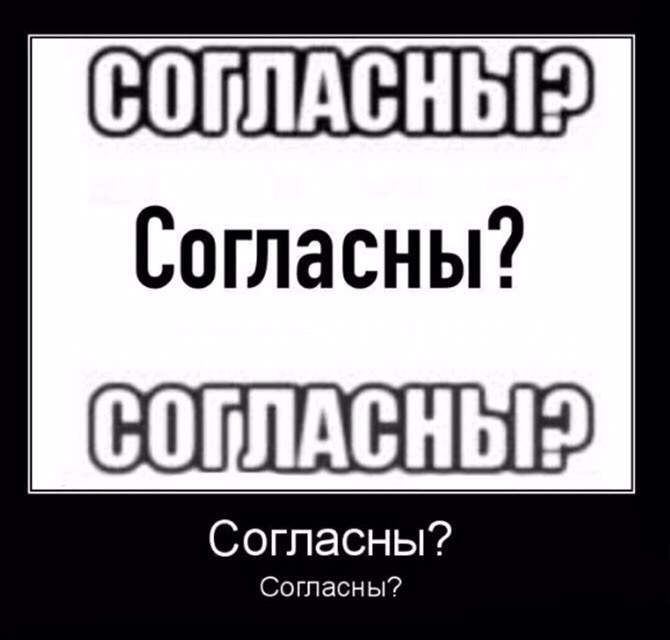
This is a demotivator: a black background with a white frame. At the top and bottom of the frame, in large bold letters with a blurred outline, it reads “AGREE?”. In the middle, the same word is set in a sharp, narrow typeface.
Below the frame, on the black background, is a caption in white type: “Agree?” first, larger, and below it the same thing in small print. The frame contains no person, object or plot. The meaning of the meme lies not in the picture but in the phrase itself and in how it is placed next to other content. The repetition turns the question into a rhythmic, empty formula.
Where the phrase comes from
The origin of the format is not reliably established: the author of the picture and the date of first publication are unknown. Phrases like “Recognized?” and “Agree?” have long been familiar from social media posts, where a question to readers is meant to provoke comments, but the link between this particular picture and a specific community cannot be proven.
Over time, such questions broke away from posts and were pasted onto pictures unrelated to any topic. The caption explained nothing, and its meaninglessness became the basis of the joke.
Why the repetition is funny
By design, a demotivator should give a pointed conclusion beneath an illustration. Here the genre is taken to emptiness: instead of an illustration, a word; instead of a conclusion, the same word. The viewer expects a meaning and does not get one, and the pause between expectation and result creates the effect.
The triple “AGREE?” in the frame recalls an insistent demand for approval. The louder and larger the presentation, the more obvious it is that there is nothing to say. That is exactly why the picture is easy to use as an ironic reply in an argument where the other person is trying to force agreement.
Examples of captions and how they work
Example one: “Monday, eight in the morning. Recognized? Agree?” A calm everyday moment is presented as a question that demands general agreement. It is funny because the question sounds as if it matters.
Example two: “Mom asked why you're not answering in the chat. Agree?” Here the question politely shifts the conversation into a field of agreement that does not actually exist. The gap between the mundane reason and the solemn tone works like a pause before an answer.
Example three: “Someone posted a chat screenshot with no context: — Agree? — Recognized? — Agree?” Three lines in a row work like an argument in which nobody has explained anything, while the question keeps sounding insistent.
In all the examples, the caption takes an everyday pretext and dresses it in the tone of a vote: the smaller the reason and the more serious the question's intonation, the more obvious the gap between form and content.
Where this template fits
The picture suits short replies: in comments, in chats with friends, under a post where a soft question without an answer is wanted. It is better to put it under something specific, otherwise the joke loses its footing. A short caption next to the demotivator frame sharpens the contrast, while a long text blurs it.
The demotivator style makes the picture look like an old framed poster, so it pairs well with nostalgic topics. In public discussions a repeated phrase may be taken for a pushy tactic, while in friendly chats it is usually harmless, so there you can add your own text.