The core of the joke
The meme is based on wordplay with forms of Russian names. Kolya is a diminutive of Nikolai, Tolya of Anatoly, and these correspondences are fixed in Russian: we easily understand which name stands behind each short form. The joke is that, by analogy with these pairs, one can invent nonexistent "full" forms that sound absurd, and then ask why they don't work.
The catalog's description says the meme is based on an old tongue-twister-style rhyme — that is, a poetic joke built on words that are hard to pronounce quickly. The device itself — swapping one element for a similar one and demanding logic from an obviously absurd construction — is typical of that genre. The seriousness of how the question is phrased is what creates the comic effect.
Variants of the text in the image
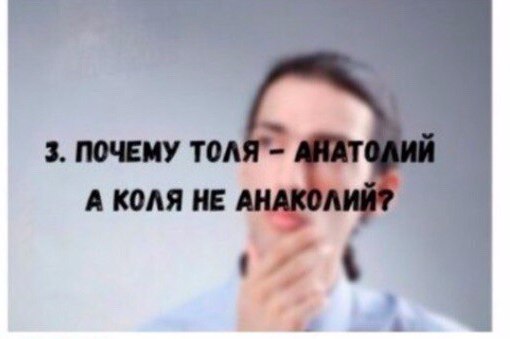
The picture shows a different version of the same joke: a person with a hand under their chin, with "Why is Tolya Anatoly, but Kolya isn't Anakoly?" written against a blurred background. The caption starts with the number "3," hinting at a series of similar questions, though the existence of such a series is unconfirmed.
The text in the picture differs from what's stated in the description: the catalog mentions a variant "Nitolai," while the image has "Anakoly." These aren't different memes but variants of the same device: a name is taken from which a short form was derived, and the reverse construction is built, which sounds absurd. This discrepancy is noted as a caveat.
Origin
The meme's origin couldn't be established. A search by the wording and the title turned up texts about Russian names and literary and forum posts, but none of them turned out to be the original source of this specific joke or stated the date it appeared.
The year 2011 given in the catalog isn't confirmed by independent sources. It can be kept in the article as catalog information, but not as an established fact. The joke's author and the first platform where it appeared are also not established.
Its place in russian humor
Wordplay with names and tongue-twisters has a long tradition in Russian humor. Such jokes rely on recognizable language mechanisms: the reader immediately grasps the rule and notices it being broken. That's why such formats easily move from spoken language into captioned pictures.
The picture-and-caption format is convenient for spreading: a short phrasing, a recognizable shot, and a question that invites continuation. Users often suggest their own variants with other names, which explains the device's staying power even when the original post remains anonymous.
Why the joke works
The main source of the comedy is absurdity built on seemingly correct logic. If Kolya is Nikolai, then by analogy a form should exist for Tolya too, and the question seems reasonable right up until you try to say it out loud. This logical trap for the reader is what produces the smile, and it doesn't require knowing any specific context.