A face against a stranger's street
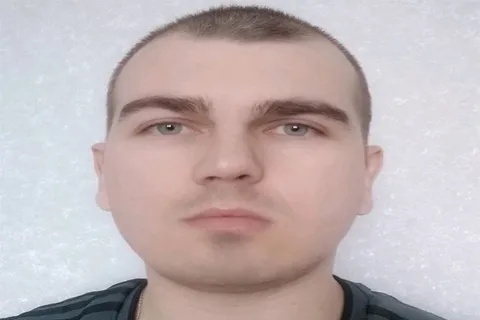
The close-up shows a man with short hair and light stubble in a dark quilted jacket with a red collar. He looks straight into the lens, as in a selfie. Behind him is a blurred city street: light-colored cars and a building with old-style windows. The frame suits the joke because the background looks like any European city, and the man in the center stands out for nothing except his calm gaze.
According to descriptions, the photo was taken a few years before the meme's popularity, around 2016. The exact location and circumstances of the shot are not established, so it is better not to attribute the photo to any specific city.
Who Andrei Gaidulyan is
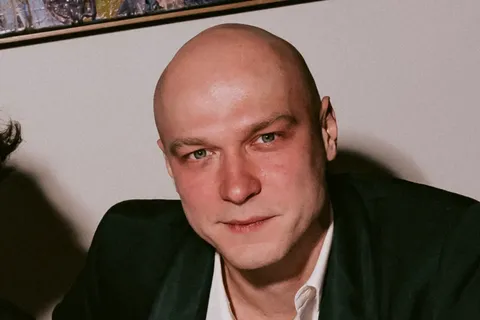
Andrei Gaidulyan is a Russian actor. A wide audience knows him from the comedy series Univer and SashaTanya, where he played a character named Sasha Sergeev. In memes next to this photo the nickname 'Deb' often appears.
What matters is that the target of the joke is not the actor's personal life but the image itself: a familiar face from TV series who could supposedly turn up anywhere. According to reports, the actor himself took his internet fame with self-deprecating humor.
How the joke spread
Identical posts appeared in city groups and social media pages, following one template: 'Did you know that this year the star of the sitcoms Univer and SashaTanya, Andrei Gaidulyan, visited our city?' The same photo was attached to each post. Exact dates in different retellings vary: most often 2020 is named, sometimes 2021.
Later the format changed: the photo began to be inserted into absurd and conspiratorial pictures with hints of hidden messages. The joke about city visits turned into post-irony, where any explanation sounds like the 'solution to a secret plan.'
Why it is funny
The meaninglessness of the claim is funny. 'Visited our city' is presented as an important fact, but there is no reason or benefit in it. The more solemn the tone and the more serious the design, the stronger the absurdity.
Another layer is the flash mob. When the same phrase is repeated by dozens of communities, the repetition itself becomes the joke, as if the city had to report on this event.
There is a third layer: the face in the photo is unremarkable, so anyone can insert their own yard, shop, or chat. The universality of the background makes the template suitable for any place.
Examples of formats
The classic caption for the photo: 'Did you know that this summer Andrei Gaidulyan visited our courtyard?' It works by scaling down, from a city to a courtyard.
'Did you know that Andrei Gaidulyan visited our kitchen at 3 a.m.?' The same template, but with everyday absurdity.
'He was here. He has always been here.' A caption in the spirit of a conspiracy theory. The joke is the buildup for no reason.
'Gaidulyan visited our chat and left without reading the messages.' An example for a narrow circle, where the joke adapts to any group.
How to use the photo
It is better to use the picture as a portrait-as-evidence: the more mundane the circumstance, the better. Don't invent real events or rumors about the actor himself: the persona in the joke is made up.
The meme is now perceived as a reference to a certain period of the internet, so it is more often used with ironic nostalgia. It is best to keep the caption on one line above or below the portrait, without covering the face, because the whole joke rests on the calm look into the camera.