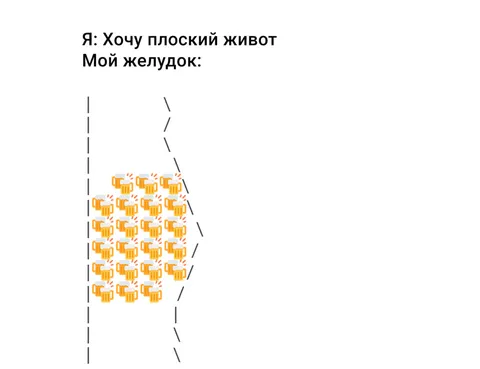
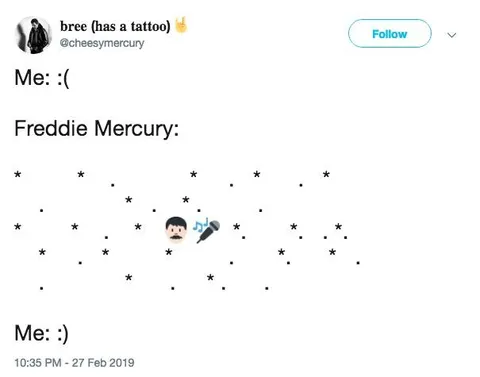
The picture can be assembled from letter characters
The format grew out of text art: circles, lines, and angular symbols combine into figures and steps. Such images are commonly called ASCII art, although specific versions also use Unicode characters. They are easy to send in a message without uploading a separate photo. The drawing turns a limited set of printed elements into a small action, while ordinary words beside the figures explain who is playing out the scene this time.
One of the early known staircase variants appeared on Twitter on March 2, 2014, from @wellyngtonesco. In it, two heroes were assigned political roles. In April of the same year, other comparisons appeared, including musical tastes. Similar text figures existed before as well: a person might, for instance, be pushed off a cliff. So the early staircase post does not mean the device was invented from scratch. The format's return in April 2018 brought jokes about competing desires, habits, and plans; even brand accounts joined the discussions.
A ready-made winner stands at the top
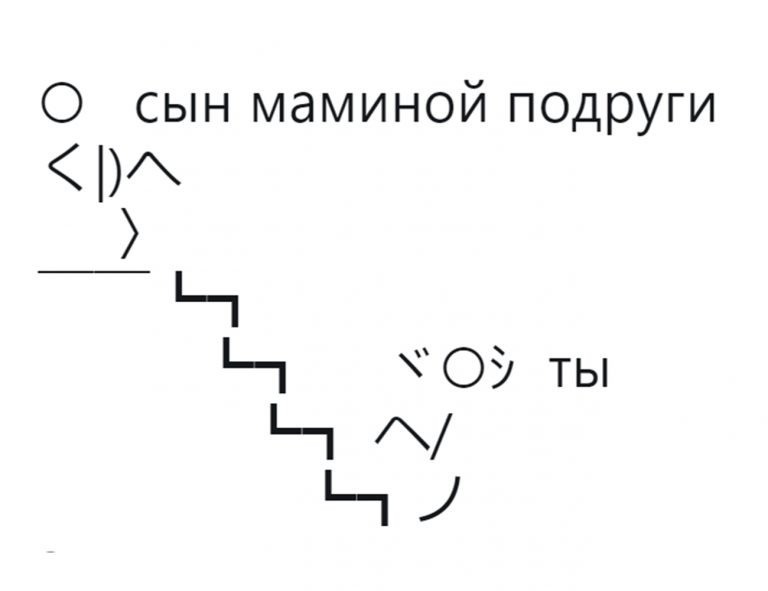
On the white field, the upper figure is on the left, near the start of the staircase. Its head is a circle, its arms and legs are lines, and one leg is raised toward the direction of the fall. Lower and to the right, the second little man flies with limbs spread. Above the first is written “my mom's friend's son,” and beside the second “you.” The file is a saved image with a text drawing: there is no photo of a staircase or of a real fall here.
The image of the mom's friend's son is tied to an endlessly successful peer who gets recalled when comparing achievements. In such a joke he exists first of all as an unattainable model. The staircase makes the familiar comparison aggressively vivid: one participant is already settled at the top, and the other is not left any room beside him. The caption “you” invites the reader to take the losing position and recognize their own irritation at yet another comparison.
A victory no one argues with
Two characters may stand for people, but more often they become abstract forces. A desire, an event, or news occupies the upper position, while the losing plan goes down. The comedy arises from an overly decisive depiction of a small inner choice. Between two things one could have hesitated, yet the drawing shows that one has already displaced the other without any negotiation. Two captions are enough to name the cause and what it cancels.
The text version also depends on its silhouette. The steps lead the eye diagonally, and the lower hero's open arms separate him from the calmly standing upper one. The words need not describe every line: they assign the figures roles, and then the position of the bodies delivers the outcome. If this construction is forwarded precisely as a set of characters, the arrangement of spaces and lines preserves the scene. In a picture, as here, the mutual placement of the elements is already fixed and does not depend on the font of the chat.
Three invented cases of displacement
In an invented study caption, the upper spot reads “the teacher's sudden question,” and below falls “my perfectly memorized introductory paragraph.” The scene shows how a conversation destroyed a prepared order of answer. In another invented variant, the winner is “the table with free little pies,” and the loser is “the promise to drop by quickly and leave right away.” The staircase depicts an instant change of intent, not a real quarrel among event attendees.
The third invented scene concerns repairs: the upper little man is “a new convenient shelf,” the lower one “all my old boxes on the floor.” Here the displacement is pleasant: a successful thing destroys a habitual mess. Therefore the format does not necessarily mean harm or the author's defeat. It shows a decisive replacement, and the mood determines what got the top step and the place in the fall.