What the image shows
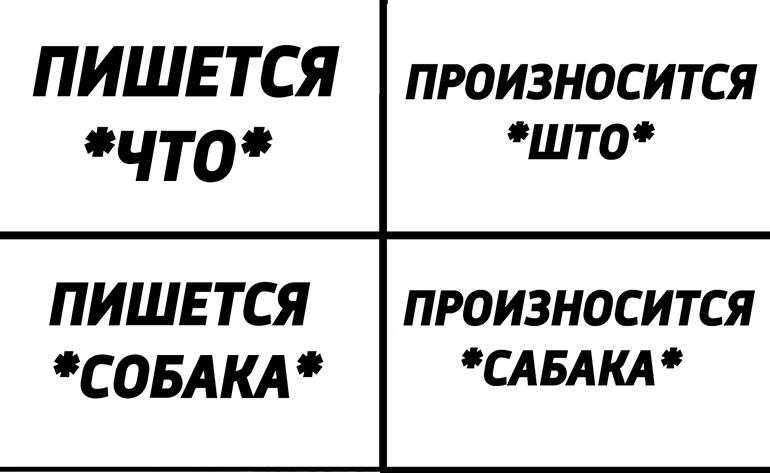
The image is divided by black lines into four cells. In each, a word is set in large, bold italic capitals, with asterisks around the key word. The top pair reads “SPELLED *ЧТО*” and “PRONOUNCED *ШТО*”; the bottom pair reads “SPELLED *СОБАКА*” and “PRONOUNCED *САБАКА*.”
There is no punchline in the frame. It is the foundation of the template: two pairs of examples that the reader connects on their own. An additional line usually adds a twist, while the template itself sets the rules of the game: first the discrepancy is shown, then it is explained through an everyday situation.
Why the joke rests on pronunciation
In Russian orthoepic norms, the cluster “чт” in “что” is read as “шт,” so “што” is not an invention of the meme but a normal pronunciation that is easy to notice in everyday speech. The pair “spelled что, pronounced што” shows how far a familiar word can drift from its spelling.
The word “собака” works by a different mechanism. In an unstressed syllable, the letter “о” sounds like “а,” giving “сабака.” This phenomenon is called akanye, and it is present in the living speech of most Russian speakers. The joke lands because the reader recognizes their own voice in the example rather than an invented sound.
That is why the meme works as a simplified textbook: it does not explain the rule, but shows it on familiar words, and the reader checks it against their own pronunciation.
Where the format came from
The author, the date of the first publication, and the page where this image first appeared are not known. The genre of text memes with pairs of examples and a short joke has long been common on Russian-language social networks, but the origin of this specific example is unknown.
It is therefore reasonable to separate the genre from this particular instance. The device of highlighting a word and showing a mismatch is as old as wordplay itself, while the styling with capital letters and italics belongs to internet culture.
Caption examples for your own version
The examples are invented for this template.
SPELLED *ЗДРАВСТВУЙТЕ* (“hello”), PRONOUNCED *ЗДРАСТЕ*. This is how people greet each other in an elevator when the doors are already closing and there is no time to finish the word. The reduction works: in fast speech the greeting gets shorter, and the joke depends on the fact that almost nobody says it in full.
SPELLED *СЕГОДНЯ* (“today”), PRONOUNCED *СЕВОДНЯ*. When Friday is already over and the report is still not done. The pair picks a word with a clear colloquial reduction, and an everyday situation becomes a verdict.
SPELLED *ПОЖАЛУЙСТА* (“please”), PRONOUNCED *ПЖАЛУСТА*. When someone asks you to take out the trash that has already been taken out. The contrast between a polite formula and a careless sound creates the irony.
SPELLED *КОНЕЧНО* (“of course”), PRONOUNCED *КАНЕШНА*. A reply to a request that clearly will not be fulfilled. A polite “of course” sounds like a promise, while the colloquial form makes it sound indifferent.
How to build your own version
Choose pairs where the discrepancy can be heard: vowel reduction, dropped sounds, or a familiar colloquial form. The more familiar the sound, the faster the reader gets the joke.
Do not turn the template into a list of jokes about accents or regional speech. What is funny here is not how people talk but the mismatch between spelling and sound, so it is better to use common words that sound the same for most speakers.
At the end, you can add a line that connects the mismatch to an everyday situation. That step is what completes the caption; without it, the template is just pairs of words.