The diagram in the picture
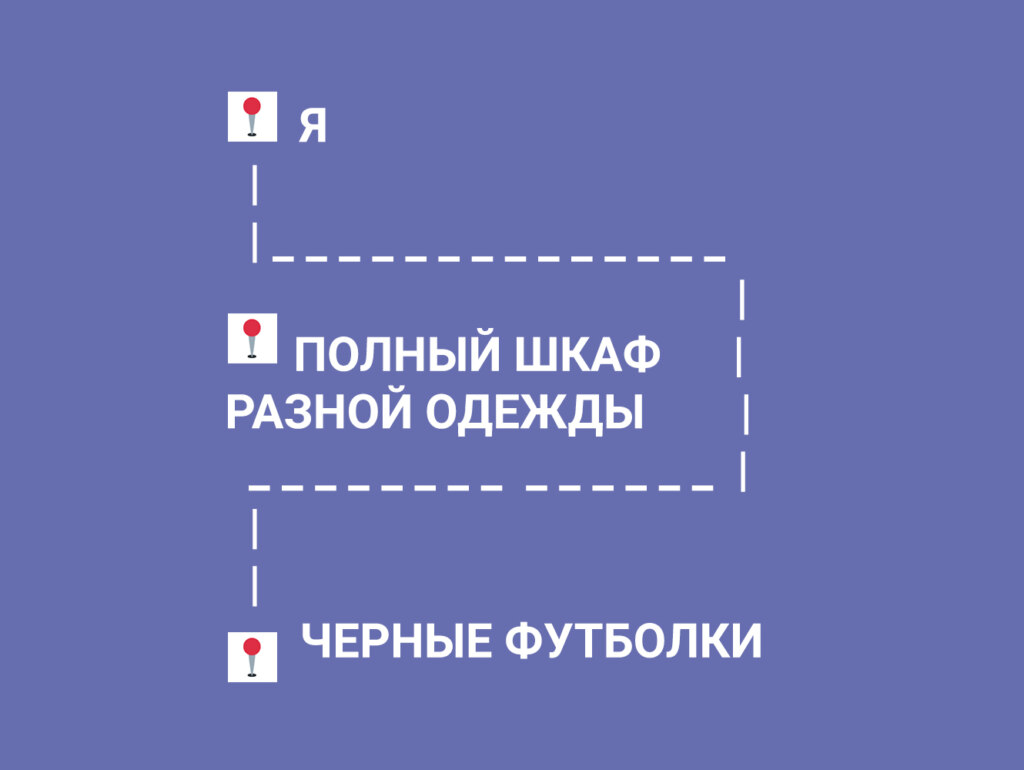
The background is blue-violet, with three dots connected by a white dotted line; each dot has a red round pin on a white square. The first is labeled “Me,” the second “FULL WARDROBE OF DIFFERENT CLOTHES,” and the third “BLACK T-SHIRTS.” The line leaves the first dot going down, turns right, then goes down and returns left to the second dot, after which it goes down again to the third.
Such a diagram looks like a route map, and the viewer expects the path to lead to a worthy destination. That expectation is where the effect lies: a long road through many possibilities ends with a very modest result.
How the path with pins works
The mechanics are simple: a starting point, a stop with a large choice, and an outcome that reduces the choice to a habit. The middle point is the biggest in text: a huge selection of clothes seems like it should yield a rich result, but the outcome turns out to be quite modest.
What is funny is not that there are many things in the closet, but that the person keeps choosing the same thing. The diagram shows the gap between the number of options and the narrow result, and this gap is clear without explanation: the picture has no hero and no action, only a route.
Where the format came from
Accounts of the format's early spread are contradictory. It is linked to social networks of late 2018, when diagrams with dot-and-pin markers were used for jokes where each dot stands for a step of reasoning. The author and the exact date of the first publication have not been established, so any specific dates should be considered approximate.
The Russian-language version with this picture is a particular case of a broader format in which a chain of dots turns into a line of reasoning with an unexpected ending. The diagram itself is what matters: its words can be rewritten with any content.
Example captions
Four variants written for this diagram. Each repeats the structure of three dots: a goal, an unexpected hook and an outcome.
“Wanted to get some sleep → watched three episodes → went to bed at five in the morning.” The middle dot describes the hook, the final one shows the outcome, and the difference between them is funny.
“Decided to buy bread → walked into a bookstore → left with three books and no bread.” The detour looks almost logical, and the outcome returns to the original goal with the opposite sign.
“Decided to come up with a complex password → came up with four options → wrote it on a sticky note under the keyboard.” The irony is that the path toward security ended in the most careless solution.
“Wanted to lose weight → ate a cake in the kitchen → ate a second one so it wouldn't go to waste.” The hook is clear at once, and the outcome strengthens the joke and makes it gentle.
How to adapt the diagram
The diagram can be redrawn in your own words, keeping the three dots and the turning line. The text should be short, otherwise the rhythm is lost. It is best to take situations where the choice and the outcome are visible: purchases, studying, trips.
The effect is stronger if you start with an ordinary promise: then the viewer sees for themselves how the path veers off. The pins are convenient to draw identical, so that attention follows the line rather than the decorations. It is worth checking that each next dot really deviates from the previous one, otherwise the outcome will stop being unexpected.