How text decoration became a separate scene
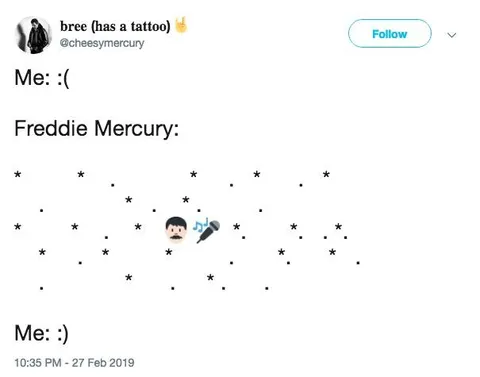
One of the early well-known posts was published by Twitter user @naottri on March 29, 2018. The scatter of text stars was combined with a drawing of a jar: the symbols looked like glowing particles inside or above the object. What mattered was not a specific plot but the ability to arrange simple signs so that they read as part of the picture.
In early April other users inserted characters from Dragon Ball and Kirby, and Netflix played with a similar glow using the character Gob from “Arrested Development.” The remakes showed that one star template could be moved between completely different works. Old posts do not let us name the author of every later collage, and the Hermione variant has no established exact date either. Its link to the format rests on the characteristic added scatter, not on the social network's interface.
Hermione, a quill, and the added symbols
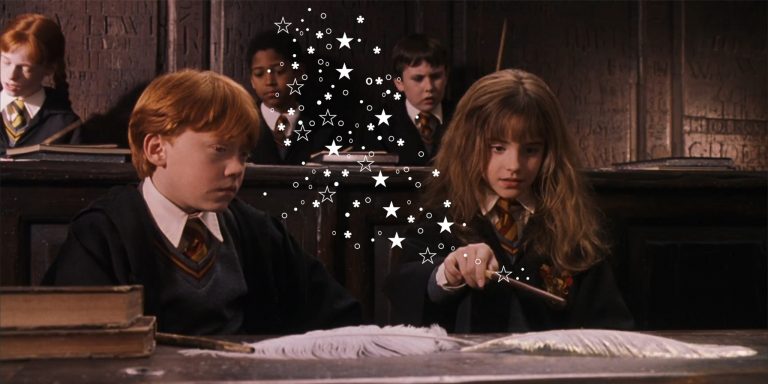
The picture uses a spell lesson from the film “Harry Potter and the Philosopher's Stone.” On the right Hermione directs her wand, on the left sits Ron; books and a white quill lie on the table. Other students are visible behind them. Above the wand and between the rows stretches a white column of stars, circles, and dots: it is laid over the image and turns a small action into a conspicuous glow.
In the original plot Hermione successfully casts the levitation charm the class is learning. Therefore the choice of frame immediately gives the symbols a clear role: the viewer links them to the work of the wand. However, the decorative stars belong to the remake, not to a description of the film's original effects. The picture itself has no field for a tweet, an account name, or a ready-made phrase; the meaning is created by joining the movie scene with the text ornament.
Text that behaves like a drawing
Stars are unusual in that they keep a dual function. Individually they are familiar signs that can be typed on a keyboard; together they depict light, dust, or sparks. The spacing between the symbols matters more than the ordinary order of letters. They set the shape of the cloud and the direction of its movement, even though the image remains still.
Pairing with a character adds an implied cause for the glow. The wizard seems to produce the stars, the jar holds them, and the object under the scatter gets a solemn halo. The funniest effect arises when the result of such decoration is too modest: an ordinary thing looks like a rare artifact. In the Hermione variant the decoration supports the real magic of the plot, while a future caption can sharply shrink its scale to a mundane task.
Small miracles under a big glow
In an invented variant the lesson is captioned “when I opened the jar on the first try.” The scatter of stars equates an everyday effort with a successfully learned spell. Ron can remain an observer for whom the event seems less remarkable than it does to the one performing it. Thus the frame lets one show both a sense of triumph and the modesty of its cause at once.
Another invented version places stars above the only clean mug left in the morning. The object becomes a treasure because in this particular situation it is hard to replace; the glow signals value without a long explanation. In a third example Hermione's wand seems to bring back a missing button in a program, and the caption talks about closing and reopening a window. Here the simplest solution to a technical problem is declared magical. In every case the star scatter serves not as an independent line but as an amplifier: it makes a small achievement look worthy of a special effect and a solemn pause.