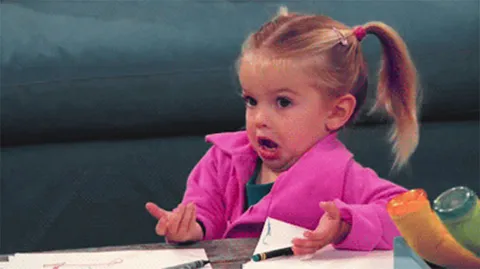
The red sweater solves the puzzle
Joey sits at the kitchen table in Monica's apartment, eyes wide, looking past the edge of the frame. This is a scene from “The One with the Red Sweater,” the second episode of Friends' eighth season, which aired on October 4, 2001. The friends are trying to figure out who fathered Rachel's baby. A red sweater left behind after a date becomes a clue; through it, Joey realizes Ross is the future father. The look appears in the instant when scattered guesses come together into an answer.
Inside the episode, the reaction is understandable thanks to the earlier conversation: the viewer follows the search and knows why this item matters. A standalone frame drops the dialogue but keeps the direction of the gaze and the instant recognition. A new caption can give him a different object of attention: a message, a mistake, or a small clue after which the earlier explanation no longer fits.
From an episode to two formats
The episode aired in 2001; the frame itself became a standalone reaction later. By the early 2010s, the scene was already appearing in GIF collections. On August 10, 2019, a four-panel version appeared on Reddit: the sequence shows a calm state, followed by an increasingly clear realization. By the end of that year, this format had spread widely. Two different ways of joking thus coexist: one photograph catches a sudden understanding, while four panels play it out gradually.
For example, a single frame fits the line “Noticed the words ‘assemble yourself’ on the box.” For four panels, one can build a whole change: a person is delighted by a package, opens the box, notices a forty-page instruction manual, and finally looks at a scatter of parts. In the first case everything rests on one discovery; in the second, on a build-up of reaction.
What one glance changes
Joey's expression can be read as surprise, disbelief, or belated recognition. A neighboring caption sets the tone: an absurd piece of news makes him seem to double-check what he heard, while a hidden condition makes him instantly revise the plan. The photograph itself does not say what exactly he has understood; the text or the adjacent panel takes care of that.
That is exactly why the frame suits stories with a small clue. The line “The file is in the folder ‘final’” sounds ordinary until next to it appear the folders “final2,” “final_for_real,” and “final_last.” In the four-panel version these names can be shown one at a time, while in a single frame it is enough to leave the last folder and Joey's look. The same source turns a short discovery into a full scene once panels are added.
Invented captions
“When the meeting is already over, but the host announces a short round of feedback.” The look marks the moment a person realizes they stood up too early. “Opened the fridge for yesterday's pizza and the box is empty” uses the same reaction for a household clue: the plan collapses in one glance inside.
For four panels, a different sequence works: “Found the perfect route with no transfers” — “read the details” — “three courtyards, a staircase, and a bus once an hour” — a surprised face. All captions in this section are invented. They change the circumstances, but the punchline stays the same: a familiar scene suddenly gets a missing detail.