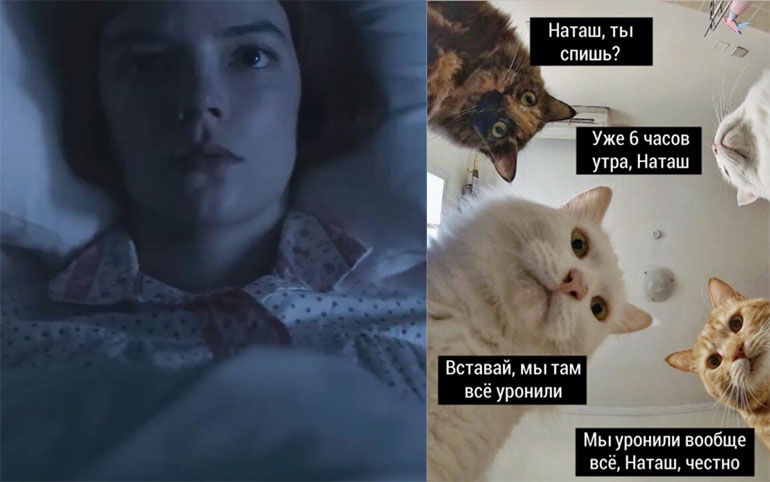
A collage of two halves
The image is split into two parts. On the left is a dimly lit frame: a girl with dark chestnut hair lies on a pillow in small polka-dot pajamas with a red collar, her eyebrows slightly drawn together, her gaze fixed upward, almost straight at the camera. The light is cold and bluish, and it's night or an early hour.
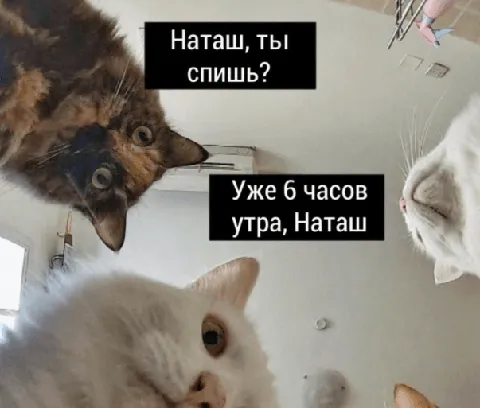
On the right is an already-established meme: four cats look up at the camera from below, as if the camera were lying on the floor or on the bed. Captions on black bars read, top to bottom: "Natash, are you asleep?", "It's already 6 AM, Natash," "Get up, we knocked everything over," "We knocked over literally everything, Natash, for real." The result is a dialogue: on the left, the person isn't sleeping; on the right, the cats start waking him up.
Who Beth Harmon is
Beth Harmon is the heroine of "The Queen's Gambit," a Netflix miniseries that premiered in October 2020. It's based on the novel of the same name by Walter Tevis, published in 1983; the series was created by Scott Frank. Beth is played by Anya Taylor-Joy.
The plot follows a girl from an orphanage in Kentucky who learns to play chess and becomes a top-tier player. Alongside that, she develops a dependency on tranquilizers that were given to the children at the orphanage. She visualizes chess games right on the ceiling above her bed, and that visual device became one of the show's memorable trademarks.
Why the stare at the ceiling became a joke
In the show, the upward stare signifies mental work: Beth plays out games in advance while everything around her is quiet. Users stripped away the chess and kept just the gesture: a person lying there, not sleeping, thinking. The meaning shifted from the heroine's imagination to ordinary insomnia.
Jokes using this frame began after the show's release, in the fall and winter of 2020. The author of the first joke is unknown, so this is really just a story of gradual spread across social media: first as a reaction to the topic of insomnia, then in combination with other templates.
Where the cats come from
The right-hand half of the image is a separate, earlier Russian-language meme. According to Russian media reports, the picture with the cats appeared in December 2019 in the community "Kotizm," and gained particular popularity in late February 2020, when the line about having "knocked everything over" started being applied to news about falling exchange rates and prices. That's how it turned into a universal frame for bad news.
The combination of the two templates creates a new pairing of meanings: the girl isn't sleeping and is staring at the ceiling, while the cats have already shown up with yet another problem. This is one of many combinations in which the "Natash" meme has been paired with other frames.
Captions for this combination
"Me at 3 AM: remembered an embarrassing moment from 2011." The left half here represents whoever's posting it, and the right half shows how the brain brings up memories on its own, without asking permission.
"Deadline's tomorrow, and I'm deciding what color the button should be." The caption works through disproportion: a huge problem and a trivial task.
"My brain, with the alarm going off in an hour: let's go ahead and relitigate literally every decision we've ever made in life." The cats turn into the voice of the brain, waking you up even though it's still too early to get up.
"At night: you're not sleeping. In the morning: you're not sleeping. All the headlines: you're not sleeping." The rhythm of repetition heightens the feeling that you'll never be allowed to rest.
How to avoid missing the mark
The caption under the left half should describe a state: insomnia, anxiety, feverish overthinking. It's better to leave the caption under the right half as-is, so the meme stays recognizable. If you do change the cats' lines, keep the same progression: first a polite question, then the time of day, then the confession of disaster. The emotion on the heroine's face is wariness, not fear, and jokes pitched in that register come across most naturally.
The reverse move also works well: leave both halves unchanged and add a single caption that sets the time and occasion, like "Sunday, 11:59 PM." The viewer will fill in on their own what the heroine is thinking about and what the cats knocked over.