What the shot shows
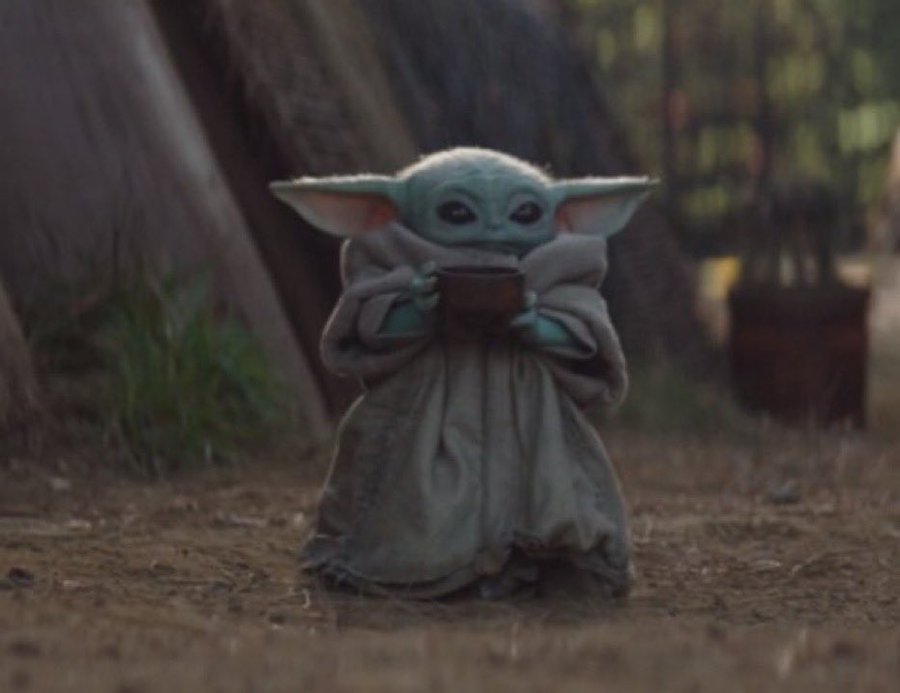
At the center of the frame sits a small green child with large pointed ears and dark, shiny eyes. He wears loose beige-gray clothing resembling a long robe. With both hands he holds a dark cup close to his face. The background is blurred: on the left a wall or hut, on the right greenery and vague objects, and the ground underfoot is dry. The light is soft and evening-like.
The child looks over the rim of the cup straight ahead, as if he is genuinely following what is happening with interest.
Where the shot comes from
The Mandalorian is a Disney+ series set in the Star Wars universe; its first season premiered together with the launch of the platform in November 2019. The unnamed character was nicknamed Baby Yoda by fans, and later, in the second season, he was named Grogu. The scene with the cup, according to the meme catalog, appears in the fourth episode of the first season, “Sanctuary,” which aired on November 29, 2019.
On the same day, a Twitter user posted an animation captioned with the claim that Baby Yoda with soup was the new “sipping tea” meme, and it quickly gathered hundreds of thousands of likes. Major media outlets also covered it.
Why it became a meme
Before this, the main template for calm observation was the frame of Kermit the Frog drinking tea. Baby Yoda took its place because, in terms of “cuteness,” he came out ahead: the cup looks huge in small hands, the pose is serious, and the eyes look as if he is genuinely taking part in the conversation.
The main point of the picture is detachment. Someone argues, swears, or gets into an absurd situation, while the hero silently sips. The meme emphasizes not indifference but the observer's enjoyment. It is precisely this gentle, almost cozy version of neutrality that sets it apart from more biting reactions.
It is also worth noting the character of the humor: the scene in the series itself is peaceful and contains no irony. The joke arises only at the moment the frame is moved into a foreign context, where the child's calm suddenly becomes a comment on someone else's drama. This is a typical mechanism of reaction images, in which a neutral episode gains meaning from its caption.
Caption examples
“Two coworkers arguing in the chat while I'm reading.” A classic of the genre: the drama goes on without your participation.
“When the group starts settling who's right in the argument about pineapple on pizza.” The cup here turns into a ticket to the show.
“Me when the boss asks who has ideas and everyone stays silent.” An example with a touch of self-irony: silence is depicted as comfort.
“Mom when she sees the kids sharing their presents.” It's funny because the parent's calm looks well earned.
How to use it
The picture suits short reactions in chats and comments, where you want to show that you are watching what is happening without intervening. It is not suitable for serious complaints or someone else's grief. The longer and more chaotic the situation described in the caption, the better the character's calm works. If you add text, place it above or below the little one so as not to cover the cup and face.
A good technique: describe in the caption a situation where the viewer already expects a stormy reaction, and then post the frame as the reply. The higher the intensity of what is happening in the text, the stronger the imperturbability works. For calm topics the meme looks bland, because it lacks contrast.