The frame and its atmosphere
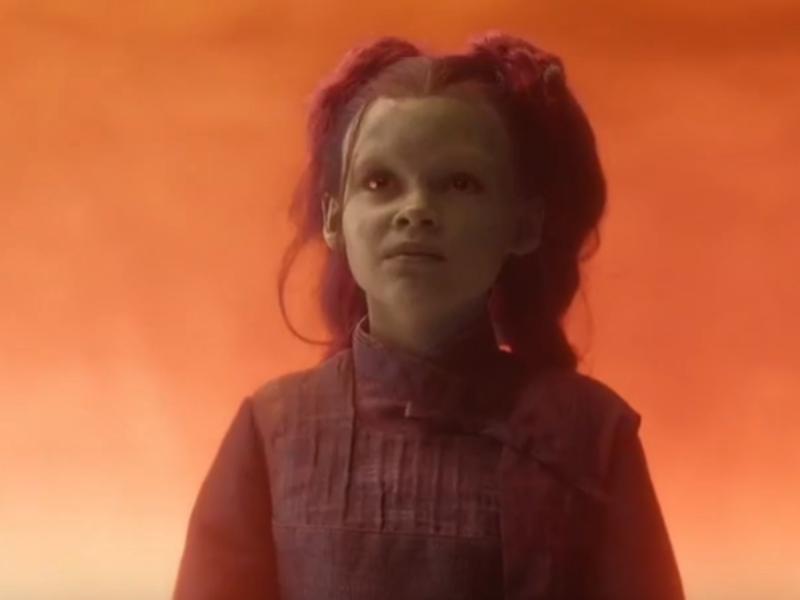
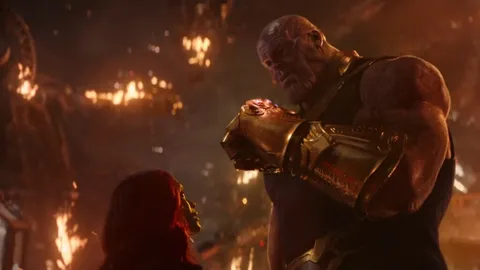
The whole background of the frame is washed in an orange-red haze, so the girl's figure stands out against a solid color. The heroine's hair is crimson-magenta, gathered into two buns with loose strands. Her clothing is dark, with a fastening at a high collar, and her skin has a greenish tint, like the character in the film.
Her gaze is directed upward and slightly to the side. The expression is calm, almost focused, without tears or anger. It is this restraint that makes the frame useful for captions where a quiet, heavy answer sounds stronger than a loud one.
Scene and lines
The frame comes from the episode in which Thanos finds himself in the world of souls and meets a young version of Gamora. She asks whether he did it. He answers: “Yes.” The next question: “At what cost?” — and the answer: “The cost of everything.” In the story this refers to the sacrifice the villain made for his goal.
The lines are short and built as a three-step dialogue: a question, a confirmation, a question about the cost and the result. Such a structure is easy to transfer to any everyday occasion, since a joke needs only the rhythm.
Why the phrase became a template
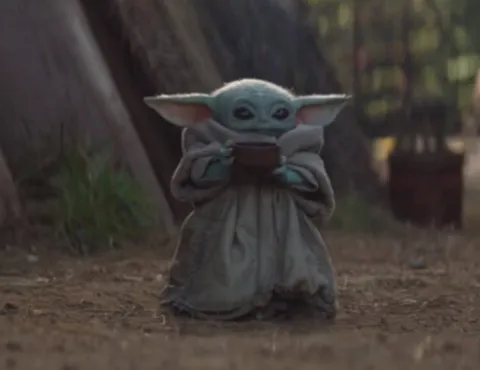
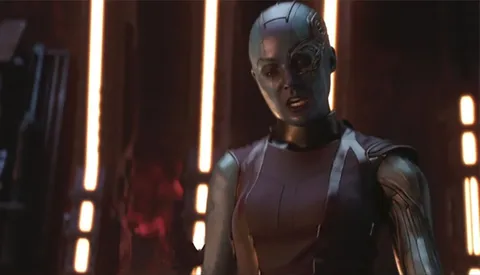
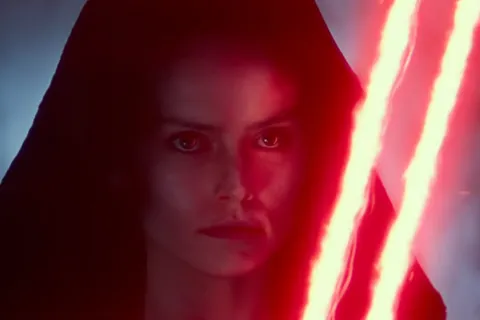
Short dialogues with one-word answers are easy to remake. The structure is simple: a question about the result, a confirmation, a question about the cost, and an unexpectedly large total. That is why the picture was remade with different characters and captions, and the joke moved from topic to topic.
The film came out at the end of April 2018, and the format was quickly picked up in fan communities. The exact date of the first remake could not be established, so the mechanics matter more here: the smaller the occasion, the funnier the solemn answer.
Examples of captions and their logic
Example one: “— Did you win the lottery? — Yes. — At what cost? — The cost of everything: the apartment, the vacation and the salary all went on tickets.” The question about the win sounds joyful, but the answer turns the joy into a list of losses.
Example two: “— Did you do your homework? — Yes. — At what cost? — The cost of my weekend.” A minor task gets the same solemn answer as a major one, and the gap creates the humor.
Example three: “— Did you ship the project? — Yes. — At what cost? — The cost of a month's sleep.” The caption keeps the structure of the original but moves it into office life.
Example four: “— Did you buy a new phone? — Yes. — At what cost? — The cost of everything.” The short version shows how repetition works: the viewer already knows the rhythm and expects the ending, and the finale lands harder than expected.
The point of the joke and its limits
In the film the line describes a heavy sacrifice, while in memes it is usually used for mild irony: the desired thing was obtained, but the price turned out higher than expected. It is important to separate the plot of the joke from the fate of the characters. Gamora is a fictional character, and captions for her frame are better kept within irony about an everyday price, not about the tragedy of the story.
For a caption it helps to pick an example where “everything” sounds like an exaggeration. Then the reader takes the joke as a game with scale rather than a literal total. The best prompts are those where the cost is really small but is presented with an epic, serious face.