What is depicted in the frame
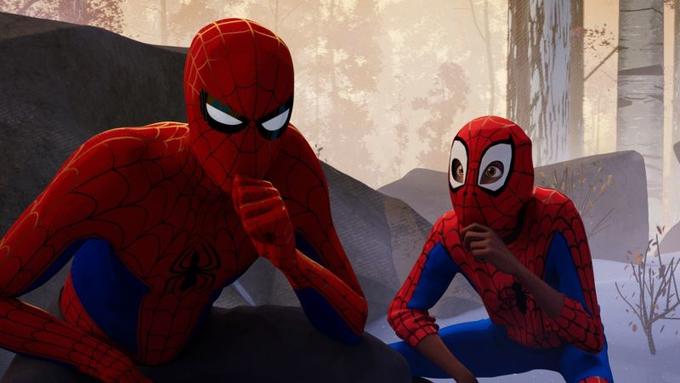
Two characters in red-and-blue suits with a web pattern sit on rocks against a blurred forest with a light haze. The larger hero on the left has raised a fist to his mouth and looks sideways with the squinted white eyes of his mask. The smaller one on the right also holds a hand to his face; his masked eyes are wide open, and his gaze is directed at his neighbor. Both look thoughtful, but the younger one is clearly copying the older one.
This is a hand-drawn computer frame, not a photograph: there are no real people here, so the discussion covers only the poses and expressions of the characters.
Where the picture comes from
The frame is taken from the film “Spider-Man: Into the Spider-Verse,” which opened in American cinemas on December 14, 2018. The older hero is Peter B. Parker, a weary Spider-Man from another universe, and the younger one is teenager Miles Morales, who is only learning to be a hero. According to the scene’s description, Peter teaches Miles, and Miles repeats his movements.
Jokes with this frame appeared in the first days of January 2019; reportedly, one early version compared two film studios, one of which ‘learns’ from the other. Which post was the very first is not reliably established, so early January should be considered early known examples rather than a proven birth date of the meme. Later the format separated from the film: what matters is the scheme ‘experienced and imitating,’ and the characters can be anyone.
How the comparison format works
Two figures are assigned roles: one is the ‘teacher,’ the other the ‘student’ or the one who copies. Their poses are identical, and the caption explains how their position and experience actually differ. The meaning arises in the gap between identical appearance and different content.
There is also a second layer. The older one holds his hand to his face with the air of an expert, and the younger one does the same but looks less confident. The viewer reads this as an attempt to look just as clever, and the joke is that it doesn’t quite work. It is this gap that makes the frame convenient for comparisons: no one has to be better, only which of the two is learning.
Three captions that rest on the pose
Examples invented for this template.
“Experienced employee: first, look at the spreadsheet. Newbie: looking and thinking how not to end up in it.” The pose shows that the newbie is trying to look equally serious, and the caption turns the resemblance into a joke: he copies not only the actions but the facial expression too.
“Me: signed up for the gym starting Monday. Monday: watching me from over there.” The gap between the resolve in the pose and the real action, which hasn’t happened yet, is funny.
“The boss talks about the deadline, and the intern is already figuring out how to survive it.” The senior has experience, the junior has a survival thought. The more precisely the caption assigns the roles, the clearer the joke.
How to use the template
The picture reads well even at a small size: two identical figures, one larger. For a caption it’s enough to indicate who teaches and who learns, then add a detail that contradicts the pose.
For a subtler joke, the roles can be swapped: let the student start explaining while the teacher looks at him with distrust. These are cartoon heroes, so the captions can be anything, but it is better to compare situations and habits rather than specific people.