Game brothers enter a debate
The format appeared in notable English-language posts in summer 2018. Among the early traces is a post by Gina_Rolinu in the r/dankmemes Reddit community dated June 21. In it, the brothers from Super Mario were credited with answers to a public question, sharply differing in tone. In early July, similar pairs spread in other communities, gradually turning two game heroes into permanent participants in an imaginary debate.
These are not quotes from Nintendo games. The meme assigns the characters the roles a specific joke requires: Mario reasons restrainedly and in detail, while Luigi cuts the explanation short with a rhymed provocation. The format has no mandatory distribution of political views. What stays stable is above all the style of speech, while the topic and positions can change. Luigi's calm, friendly appearance is especially useful for contrast with how unexpectedly sharp the line attributed to him turns out to be.
The red and green halves
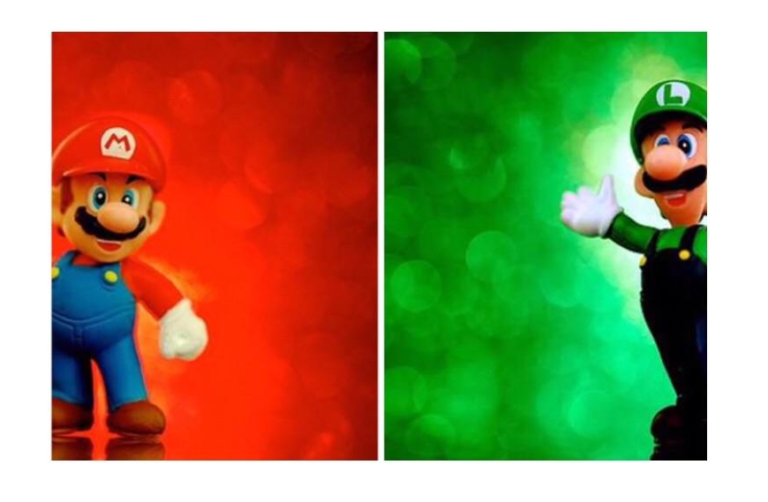
The image shows two rectangular fields divided by a white stripe. Mario is on the left against a red background, wearing a red cap with the letter M and blue overalls. Luigi is on the right against a green background, wearing a green cap with an L; his gloved white hand is raised in a welcoming gesture. Both characters are smiling. There is neither a question nor any lines on the chosen template.
The colors and caps help assign future replies at a glance. The image does not require separate name labels if the audience knows the characters. Large empty areas of background leave room for a long line from the first participant and a short ending from the second. The friendly faces make the verbal clash especially unexpected: outwardly both look like participants in a harmless greeting, but a caption can turn this juxtaposition into an argument with sharply different rules.
The answer wins by form
Mario's long line sets the seriousness of the topic. It may list reasons, add qualifications, and look like an attempt to answer conscientiously. Then Luigi reduces everything to a few rhyming words. The short rhyme gains an advantage of pace and memorability, even though in substance it may be much weaker. The meme mocks a situation in which a striking slogan takes attention away from a more precise explanation.
Another layer is the unexpected violation of character. A recognizable hero of family games is given the voice of an overly self-assured debater. At the same time, rudeness is not the only way to keep the format: categoricalness and a rhyme that contradicts a thorough answer are enough. In an everyday remake, the two brothers may represent the author's own thoughts. The first part tries to sensibly organize life, while the second instantly comes up with a simple excuse that sounds nice and cancels all the earlier effort.
Three topics without a big argument
Invented question: “What do the brothers think about cleaning?” Mario answers: “Regular tidiness helps you find things quickly.” Luigi wraps up: “Dust settles, nobody rushes.” The detailed benefit collides with a rhymed excuse for inaction; its absurd logic is what delivers the punchline.
Second variant: “How do you save money?” Mario suggests planning purchases in advance, while Luigi says: “Haven't bought it yet, already saved up.” His solution looks maximally efficient but does not address real needs. The third dialogue concerns the alarm clock: the first brother advises keeping a sleep schedule, while the second declares “Five more minutes, the chores can wait.” Here a short, easy-to-say formula portrays the familiar victory of the wish to sleep over a cautious plan that seemed convincing just a second earlier.