A trailer that gathered the old fighters
At E3 in June 2018, Nintendo unveiled Super Smash Bros. Ultimate and emphasized that fighters from previous installments of the series were returning. The tagline “Everyone Is Here” (Russian: “Все здесь”) sounded like a promise to bring the familiar lineup together in one arena. For fans it was not a neutral phrase from a menu but the payoff of trailer anticipation: who would return was revealed one by one, turning the roster into a series of small reveals.
The title outlived the specific announcement and became a frame for parodies. Instead of the game's roster, authors slotted in famous YouTubers, TV-series characters, meme heroes and friends from their own companies. The principle is simple but does not reduce to a list of faces: each new participant is presented as yet another comeback or entry into the team, even if they have no connection to Nintendo at all.
Four cards and four battle nicknames
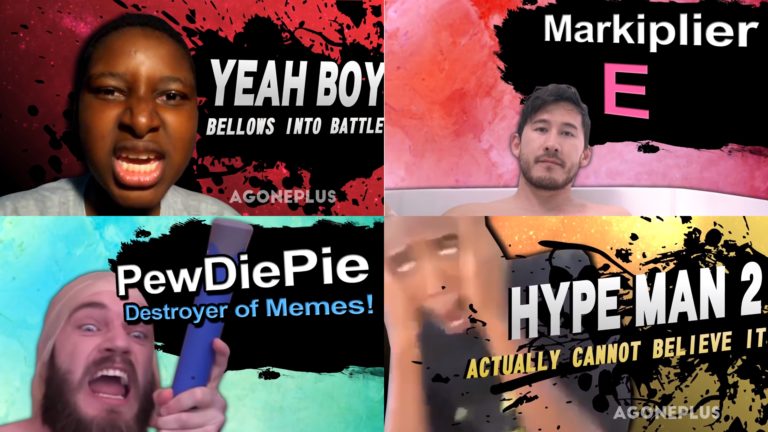
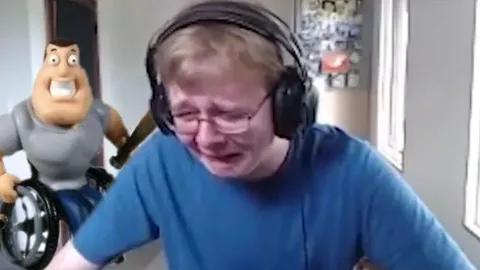
Before us are four rectangular cards with black backgrounds, colored flashes and portraits. At top left is a boy with his mouth wide open and the caption “Yeah Boy”; on the right is Markiplier with the caption “Markiplier” and the letter “E.” At the bottom are PewDiePie and another close-up of a face next to the title “Hype Man 2.” Small phrases such as “Destroyer of Memes” and “Actually Cannot Believe It” are styled like in-game epithets.
This layout inherits the energetic language of the announcement: black background, bursts of paint, a large name and a short description promise not a person's biography but their dramatic arrival in the lineup. For a viewer who knows the personalities, one caption is enough to complete the in-joke; for others the picture still looks like a fake roster that mistakes internet celebrities for fighters.
Who gets into the imaginary lineup
The parody roster works on recognizability and contrast. Imagine a fictional “household chores tournament” to which have been added “Chat Keeper” — a person responsible for all the memes — “Master of Any Chair” — a neighbor who can fix anything — and “Final Boss of the Keyboard” — a cat that invariably sits on it while you type. This is an invented example: each person is given a title as if they had a special attack, though the topic is everyday habits.
Another invented variant is a reunion of former classmates presented as the new lineup: one arrives with the nickname “King of Tests,” another as “Master of Vanishing Pens.” Each title at once states a trait of the character and inflates it into a superpower. The structure of the trailer image helps make such parodies quick to produce: the large name already promises an appearance, and the exaggerated subtitle gives the person a comic role.
From a promise of return to a shared celebration
The original slogan had a concrete stake: a huge roster of fighters, the return of characters, and the feeling that a fan would not have to choose between generations of the series. In parodies, “everyone is here” turns into a greeting for any group where long-time acquaintances or all members of one chaotic chat have finally gathered. The scale of the game is kept, but the thing being gathered becomes mundane, and therefore funny.
The formula also pokes fun at the community's habit of regarding a favorite as an obligatory participant. If a beloved blogger, character or in-joke has “made it into the roster,” they have officially earned a place among famous heroes. A caption like “Can't fight, but never leaves voice chat” creates the parody effect: the mismatch between the solemn style of the announcement and the modest ability.