A literature club with a different design
Dan Salvato and Team Salvato released Doki Doki Literature Club! on itch.io on September 22, 2017; the game later appeared on Steam. The beginning is staged as a familiar story of getting to know the members of a school club. The protagonist arrives there thanks to Sayori, writes poems, and learns the girls' personalities. However, the romantic shell gradually gives way to psychological horror, in which events go beyond an ordinary conversation within the plot.
A fan community quickly formed around the novel, including playthroughs, drawings, and reworked lines. Memes highlighted individual recognizable elements: Natsuki insists on the literary value of manga, Monika strives to hold all the attention, and sweet images sit alongside the sense that the game has stopped obeying its own rules. This is a whole family of formats rather than a single picture with a single author. Some jokes are understood from the heroines' appearance, while others rely on knowledge of the endings and of how the novel addresses the player directly.
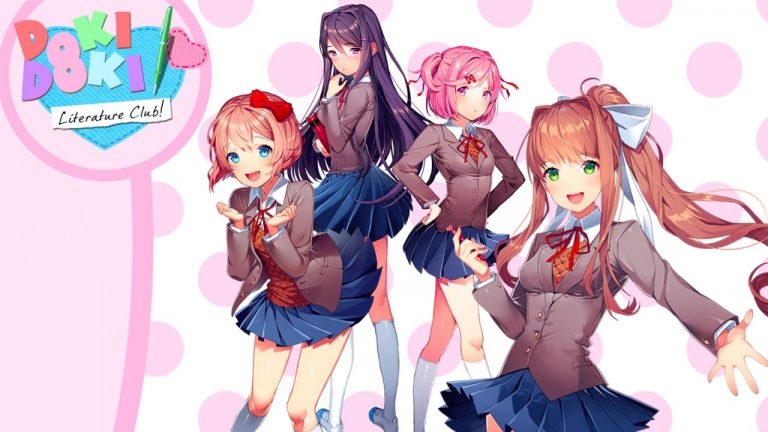
Four heroines on a pink background
The image is a promotional illustration with the Doki Doki Literature Club! logo on the left and the four club members. Sayori with a red bow stands on the left, and Yuri with long purple hair is behind. Pink-haired Natsuki stands closer to the middle, while Monika with a white bow stands in the right foreground and reaches a hand toward the viewer. All are dressed in school uniforms; the background is filled with pink circles and light stripes.
The illustration offers a pleasant introduction. Different hairstyles, poses, and expressions help tell the members apart, and the outstretched hand invites the viewer to join their company. There are no visible glitches, dialogue boxes, or frightening scenes here. That is why the meme's meaning arises from comparing the cover with the story that follows. For someone who has already finished the novel, the original invitation may sound entirely different, although no new disturbing element has appeared in the drawing itself.
A choice that seems made in advance
One of the central meme motifs is Just Monika, “Only Monika.” The name turns into an obsessive answer regardless of which member or activity one meant to choose. This device continues the game's meta-logic: the character seems to interfere with the structure of the narrative and turns other people's options in favor of her own presence. In a joke with several buttons, the options may look different but lead to the same name.
Another mechanism uses a sharp shift in expectations. Smiles, school uniforms, and a literary pastime prepare a calm conversation, while the caption recalls anxiety and the breaking of familiar rules. A meme can show two impressions of one work: before learning its real genre and after. The heroines remain recognizable even outside the horror. Fan exaggerations of their characters, such as Monika's confidence, Natsuki's sharpness, or Yuri's love of books, provide material for independent everyday scenes.
Imaginary club meetings
In an invented joke the club votes on the theme of the next evening. The cards read “poetry,” “manga,” and “novel,” and after the count all three turn into “Monika.” The format depicts a choice that was swapped out behind the scenes. Another example uses Natsuki: she brings a comic as thick as a brick to the club, and the argument about whether manga counts as literature suddenly gives way to the question of whether a bookshelf can bear it.
A third remix compares a newcomer's expectations with the memories of an experienced player. The first sees a pink poster and plans a cozy evening with poems; the second mentally checks whether the text on the screen has started living a life of its own. The comedy here arises from different knowledge of the same image. The club members who invited the viewer on the cover already carry an entire history in the viewer's memory, and the calm picture becomes the meeting point of two completely different impressions.