What is shown in the frame
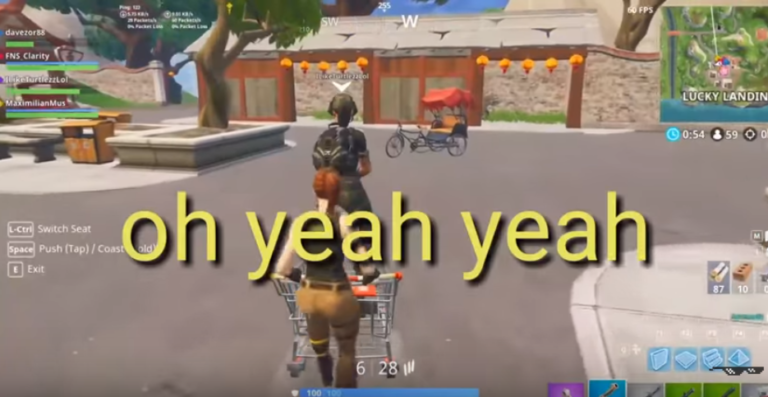
This is an in-game screenshot. In the foreground, a character with red hair pushes a supermarket cart in front of them, shown from behind. Ahead walks another character in dark clothing with a backpack. There is a road with red lanterns and a rickshaw. In the upper left corner is a list of the team’s players; at the top right is a minimap with the label Lucky Landing, a timer, and a player counter; at the bottom is the inventory panel.
A large yellow caption “oh yeah yeah” has been added over the frame and occupies the middle of the image. It is not part of the game but overlaid text, which turns an ordinary gaming moment into a meme. The frame itself shows nothing funny; the humor appears only from the caption and from the history of the phrase.
Where the phrase came from
The phrase is linked to a video about the game Fortnite, in which the game’s characters make dance moves to a repeated “oh yeah.” Details about the creator of the video, the upload date, and the exact circumstances in which the phrase appeared in the comments have not been reliably established, so it is not worth attributing them to specific people.
In January 2019, comments of “oh yeah” and its variations began to appear under videos by various authors. What had been a joke for a narrow circle of viewers turned into mass spam.
Comment spam in January 2019
The spam quickly became noticeable: the phrase was posted under videos that had nothing to do with either the game or dancing. Some viewers saw it as a funny tradition, others as annoying junk.
Among the reactions was a call by the British YouTuber KSI to change avatars and reply with the word “stop.” Accounts of the details and results of this campaign varied. This story shows how quickly a phrase can turn from a joke into a mechanical repetition unrelated to the content of the video.
Why it works as a joke
The humor here is built on repetition and meaninglessness. One short phrase, written hundreds of times, becomes background noise, and the viewer sees not the words but the mechanism of spam. That is why an image with a large caption is funny even to people who have never seen the video.
Another element is a mismatch of context. The game frame looks ordinary, but the caption drags along a story about comments. The more serious the conversation into which the frame is inserted, the stronger the contrast.
Caption examples and how they work
Below are captions made up for this template. All of them use the mechanics of repetition.
“Came for a recipe, and the comments already have three pages of oh yeah.” The caption moves the spam into an everyday situation.
“Asked a colleague to confirm the report, got the answer: oh yeah yeah.” The repetition becomes a reply to a business question, and the meaninglessness creates the laugh.
“I tell myself: the deadline is tomorrow, but all I can hear in my head is “oh yeah yeah” on repeat, like those comments.” The contrast between an important matter and an intrusive phrase shifts the tone from tense to ironic.
How to use the template
The frame suits short remarks when you need to react to a repetitive or intrusive situation. It is better not to overload the text: the caption already sets the tone, and extra explanations weaken it.
If the template is used in other people’s discussions, remember that the phrase was born as spam. Such a joke is funny in a narrow circle where it is understood, and it may look intrusive in a general stream.