What is visible in the frame
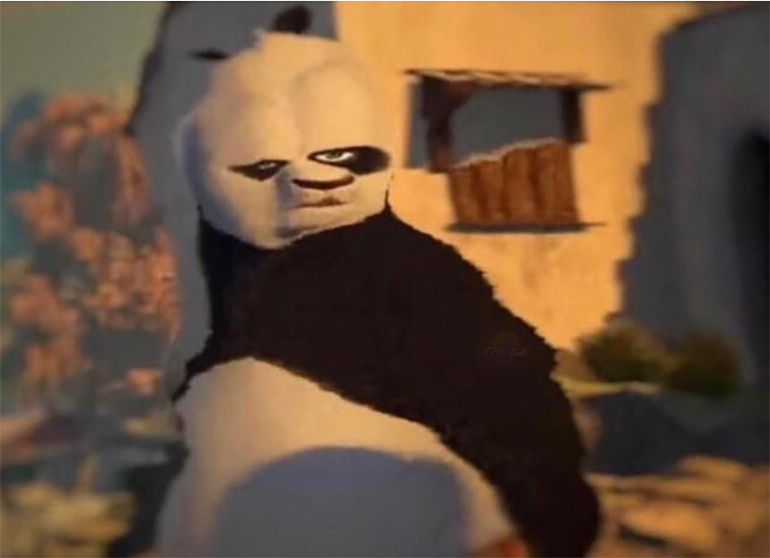
The picture shows a black-and-white panda turned sideways to the viewer and casting a heavy look over its shoulder. The face is slightly stretched and flattened, the eyes are narrowed, the brows drawn together. The background is blurred: on the left are trees in warm tones, on the right clay houses and a wooden window with shutters. The overall image is grainy and murky, as if it had been heavily compressed or stretched.
The frame looks like part of a film about the Valley of Peace from “Kung Fu Panda” (DreamWorks, the first film came out in 2008), but the exact moment and source are not established. The distortion of the face appears to come from the angle and image processing, not from the original drawing.
Who Po is
Po is the main character of the “Kung Fu Panda” series: a good-natured, clumsy and very food-loving panda who unexpectedly becomes the Dragon Warrior. The films were made by DreamWorks Animation, and in the original the hero is voiced by Jack Black. In ordinary frames Po looks friendly and funny, so the angry, distorted version sharply contrasts with him.
It is precisely the difference between the familiar image and what is visible in the picture that makes it interesting. The viewer knows the hero and expects a smile in advance, but gets a scowl and an oddly shaped head.
Why the distorted frame is funny
Such pictures are usually classed as “cursed images”: familiar things shown in a way that causes mild discomfort. There is nothing frightening in the frame, but the wrong shape of the face and the menacing gaze create the effect of “something is off.”
Because of this, the picture conveys suspicion, a silent threat or the reaction “I saw everything” well. The joke is built on exaggeration: an ordinary situation is accompanied by a face as if something serious had happened.
In chats the picture is used as a reply to an obvious lie or a strange excuse. The distorted face conveys a silent “I see everything” better than any text.
Examples for your own caption
“Me, when my brother says he ate the last piece of pie, and there are crumbs on his face” — the heavy gaze conveys suspicion better than anything.
“The face of a colleague when I say I moved the meeting to Friday” — silent displeasure expressed in a single frame.
“My reaction when the recipe says ‘a pinch of salt’ and the salt was half a jar” — a reaction to a ridiculous slip-up.
“The cat, when I go to the kitchen without it” — the caption transfers the expression onto another character and works through an unexpected comparison.
How to use it
Take the picture where a gloomy, suspicious or distrustful look is needed. The more mundane the reason, the funnier the contrast: a huge stare for a minor problem.
There is no need to explain that the picture is distorted: viewers see it themselves. Short captions with no extra words work best, so the face remains the main element.
Captions with a quiet everyday threat work well: someone else's sandwich eaten, or an unkept promise of “I'll be quick” — such small transgressions combine best with the panda's heavy gaze.
Do not caption the picture with the names of real people: the joke is aimed at everyday situations and facial expression, not at a specific person. This way the meme stays harmless and understandable to any reader, even someone who has not seen the cartoon.