What the photo shows
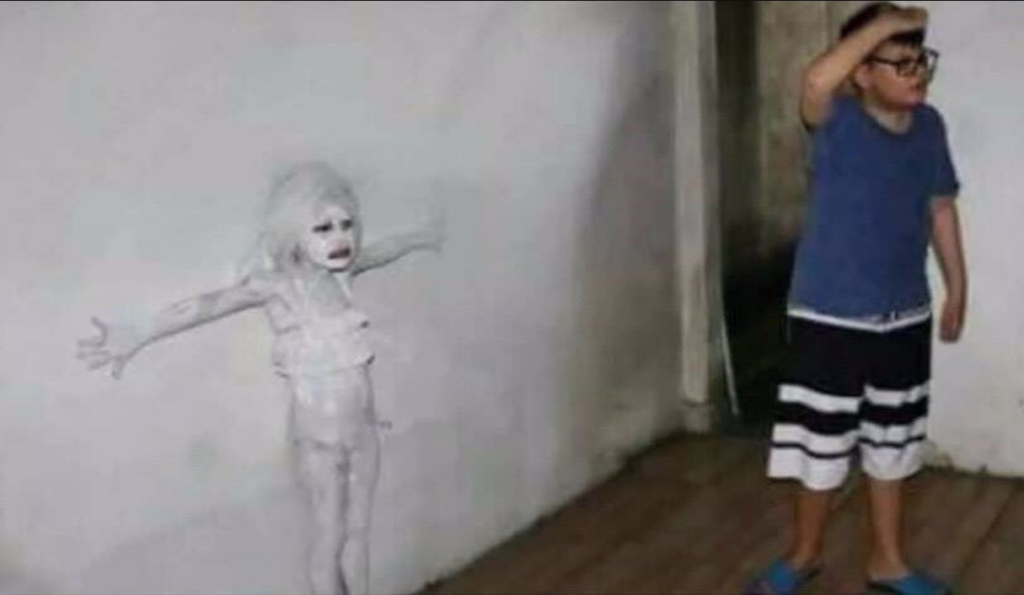
The shot features two people: a boy in a blue T-shirt and striped shorts standing at the entrance to a room and shielding his eyes with one hand, as if frightened or embarrassed, and a child on the left, fully painted white and pressed against an equally white wall with arms and legs spread out. Body contours picked out in darker paint create the effect of a semi-transparent silhouette. The figure is at once visible and seems to dissolve into the background.
It is this combination of recognizable human outlines and near-complete visual merging with the surface that makes the photo so memorable. At first glance it seems a ghostly drawing is emerging on the wall, not a painted person.
The body-paint illusion technique
The technique used in the photo belongs to the popular genre of body-paint illusions. The model is fully covered in paint matching the background (a wall, asphalt, drapery), and then, from a particular angle and under certain lighting, the body partly or completely “dissolves” into the background. Body artists use this method to create striking photos in which a person appears invisible or transparent.
In this case the effect is amplified by the pose and expression. The splayed limbs and the distorted, almost grotesque face give the figure a resemblance to a ghost or phantom, which explains why the image is perceived as frightening rather than merely technically impressive.
Spreading as a scary story
The photo became known primarily not as a demonstration of an artistic technique, but as a short visual “scary story” that people forwarded to each other in messengers and on social networks with captions like “I can’t figure out what’s wrong with this photo” or “look closely.” This way of presenting it, without an explicit explanation that the viewer is looking at body art, heightened the surprise on first viewing.
There is no documented source for the photo: no name of the author, exact location or shooting date. The image circulates online tagged “2017” with no link to a specific author or event, so its original source cannot be considered established.
Why the illusion keeps hooking viewers
The effect rests on a basic cognitive mechanism. The brain expects to see either empty space or a person on a wall, and struggles with an in-between state in which a figure is simultaneously present and visually merging with the background. It is the same principle behind other viral optical illusions featuring people who seem to “vanish” against walls, sidewalks or fabrics.
Typical comments under such posts run like “For a second I couldn’t tell where her legs were” or “At first I thought it was a drawing, not a person.” These captions capture the very moment of recognition that makes such photos popular.
The photo’s place among similar internet illusions
The genre of photos playing on the merging of a human body with its background periodically produces new viral waves. A similar surprise effect was caused, for example, by pictures of people who, owing to perspective and lighting, looked “embedded” in asphalt or sidewalk tiles, though in reality they were simply standing behind a low curb or step. Such posts are usually accompanied by a question to the viewer like “did you get the trick right away?”, which turns looking at the photo into a kind of mini-game.
Unlike many such illusions, where the effect comes from a chance camera angle, the illusion in the photo with the painted child is deliberate. It is achieved through makeup and pose rather than a lucky coincidence, which brings the image closer to the horror body-art genre than to classic accidental trick photos.