The song was given a sequel, like a movie
Despacito came out in 2017 and became a huge international hit. On August 4 of that year, YouTube announced that the music video by Luis Fonsi and Daddy Yankee was the most-viewed video in the platform's history at that point. The song's title became recognizable far beyond its audience. From this fame grew the idea of a sequel: as if the musical number were a completed blockbuster that needed a second part with an even more grandiose launch.
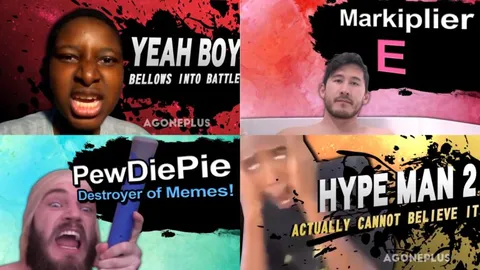
One of the early known variants appeared on HUGELOL on December 12, 2017: user WasteofBreath framed the confirmation of Despacito 2 as a message from NASA. In spring 2018 the storyline continued with video remakes, and in May PewDiePie included it in a meme roundup. By June the imaginary song was already going through a whole chain of news. Authors attributed decisions to politicians, entrepreneurs, and fictional characters, linking individual pictures into an absurd international chronicle.
What the fake broadcast says
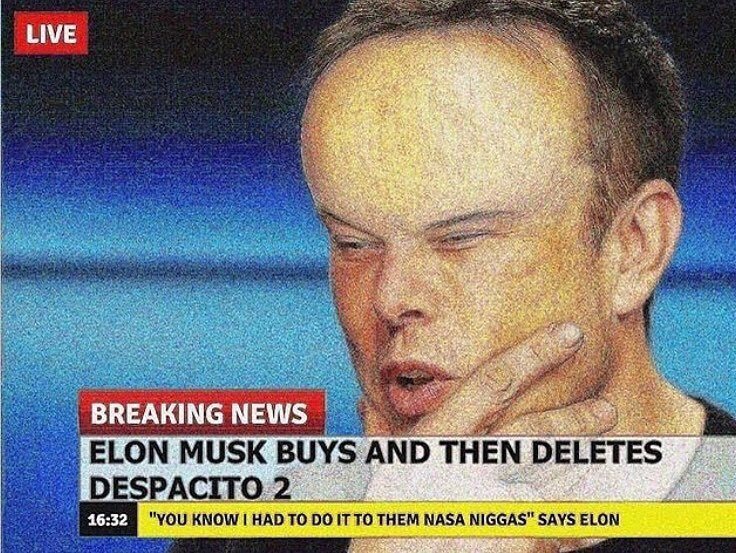
A particular edit shows Elon Musk in close-up with a hand near his face. The photo is processed so that noise, coarse colors, and reduced quality are visible. In the upper left corner stands a red LIVE. Below are a red BREAKING NEWS banner and a white headline: Musk allegedly buys Despacito 2, and then deletes it. At the very bottom, a yellow line adds a crude invented line referencing NASA.
The author of the edit and the circumstances of the original portrait are not reliably established. However, this variant was already present in meme collections from June 2018. The banners do not belong to Musk's real appearance: they form a separate parody storyline. The hand by the cheek allows the face to be read as contemplating a decisive act, but the meaning of the act is set by the new headline. Without it, the image would not be about either the musical purchase or the subsequent deletion.
Urgency grows, the meaning gets sillier
The format uses recognizable markers of television importance: a live broadcast, a large headline, a ticker, and a famous person. All of them promise an event that should affect the viewer's life. Instead, they report on a sequel to a song that, in the meme world, has acquired a fate, owners, and opponents. The mismatch between the scale of the presentation and the strangeness of the subject turns each new piece of news into an extra exaggeration.
Buying in order to delete adds a second twist. In the imaginary story, an entrepreneur gets a huge resource and uses it so that no one hears the new song. This can be read as hyperbole about fatigue with an ever-present hit. But the family also allows for an enthusiastic expectation: the next picture might cancel the ban, reveal a third part, or announce a cosmic release. The joke is sustained not by a single stable conclusion, but by a readiness to raise the stakes again within the shared story.
Three invented news items from the same universe
In a new fictional post, astronomers discover Despacito 2 beyond the Solar System and schedule a listening date three hundred years from now. The cosmic scale collides with the perfectly ordinary expectation of a track. Another example: a transport authority announces that a subway train missed its stop because it was listening to the second part. The song gains an influence that clearly does not match how a train works, and the official tone makes the absurdity even more noticeable.
The third invented headline reads: “International orchestra postpones Despacito 2 until a second conductor is found.” The number in the title becomes a literal requirement for the performers. All three news items continue the game with scale and official justifications, but each offers its own reasons for the delay or unusual release. Their fictionality is the joke itself: the viewer recognizes the serious form of the message and waits to see how far the next author will steer it from the real musical world.