The public image meets a major event
Robotic and reptilian versions of Zuckerberg existed before the 2018 hearings. Viewers reinterpreted his restrained manner of speaking, his photographs, and his technology demonstrations. The character of the jokes seemed to study human communication from a manual: any ordinary action could be given an imaginary name as a team or a software process.
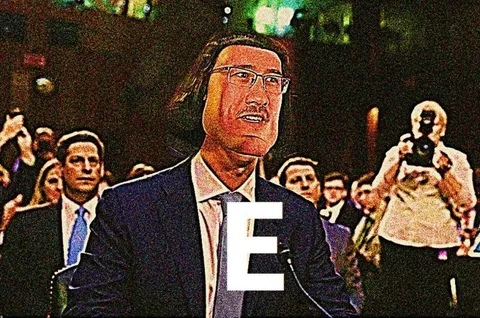
On April 10, 2018, Zuckerberg testified at joint hearings of U.S. Senate committees. The discussion covered the privacy of Facebook users, the use of data, and the history of Cambridge Analytica. The public event, lasting many hours, produced a large number of photographs and short videos that could be pulled out of the sequence of questions. In memes, his fixed gaze, his pauses, and the moments when he drank water spread widely. The serious agenda supported a separate branch of jokes about a man who knows more about users than an ordinary interlocutor would expect.
A face against the audience
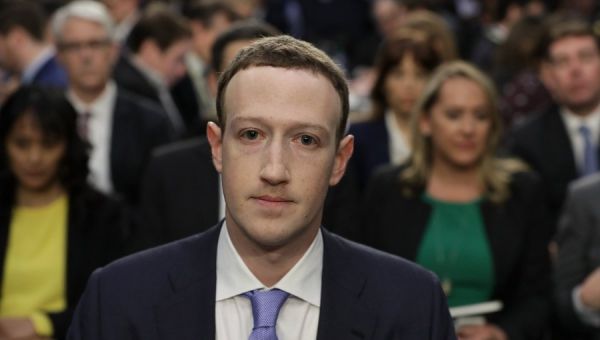
In the photograph, Zuckerberg is shown almost from the front, roughly to the chest. He wears a dark jacket, a white shirt, and a lilac tie. His lips are closed, and his face keeps a restrained expression. Behind him are people in the hall: they are visible enough to indicate a public setting, but the main subject remains the face in the foreground.
The frame contains no glass of water, no finished caption, and no altered body. Its expressiveness comes from the calm pose and the context of being watched. The character looks at once like a participant in an official conversation and the object of attention from the entire audience. In an ordinary photograph, such stillness might signal concentration. The meme caption attributes a different reason to it: the hero supposedly is calculating the right reaction, keeping a secret, or waiting for a download to finish.
The imaginary robot has a social task
The robotic version is built on translating human gestures into the language of machines. A smile becomes an executed command, a pause becomes request processing, and a glance becomes data reading. This makes it possible to show a familiar awkwardness very literally. A person wants to behave freely but thinks about every movement, and the people around notice exactly this excessive preparation.
Jokes about data use a different twist. The hero answers too precisely a question nobody asked him, or recalls a detail of someone else’s life before the owner does. Here, the historical context of Facebook gives the portrait an additional role. In one picture he plays an unsure participant in a conversation; in another, a silent holder of information. The reptilian fantasy adds an even more absurd distance: an everyday habit turns out to be part of a creature’s attempt to fit in among people.
What overprepared naturalness looks like
An invented caption for the portrait: “When you rehearsed the introduction in advance, and then someone immediately asked you about the weather.” The hero seems to have lost the necessary item from the instructions. The restrained face suits the moment before an answer, and the people behind him strengthen the feeling of a public test.
In another invented situation, a new employee tries to start a conversation by the coffee machine: “Say a line about Monday. Wait for an approving nod.” A third example uses the theme of information. In a family chat, someone writes that they don’t remember where they left their keys, and the portrait replies: “In the kitchen, under the bill you didn’t pay.” This is an invented exaggerated answer that links a recognizable image with everyday forgetfulness. The first and second scenes are funny because of a lack of spontaneity, and the third because of an excessive amount of unexpectedly available knowledge.